

PolarFire® FPGA Ethernet Sensor Bridge Platform
Date : 31 Aug 2026
Aurthor : Owen Zhang (FAE Manager)
Connecting Four Cameras Straight to the GPU with One Network
A Compact, Deterministic Sensor Access Solution for NVIDIA® IGX™ / Thor™ / Jetson AGX Orin™
60% Smaller Size · Four MIPI CSI-2 · Dual 10 GbE · Native Jetson Connector
"In the system checklist for edge AI, GPU compute power, model accuracy, thermal design, and power consumption usually steal all the attention. However, what truly determines project progress is often the most overlooked link: getting camera data reliably, with low latency and predictability, into the hands of the GPU. The PolarFire FPGA Ethernet Sensor Bridge platform is built precisely for this "last mile.""
I. The "Last Mile" of Edge AI: Sensor Access
Robots, autonomous mobile devices, and industrial vision systems are rapidly moving toward multi-sensor architectures: stereo vision requires binocular setups, surround-view perception requires four cameras, and multi-modal fusion adds even more. Consequently, proprietary sensor interfaces bring wiring complexity, distance limitations, closed protocols, and high driver adaptation costs—meaning almost every time you change a sensor, you have to redo both hardware and software adaptation.
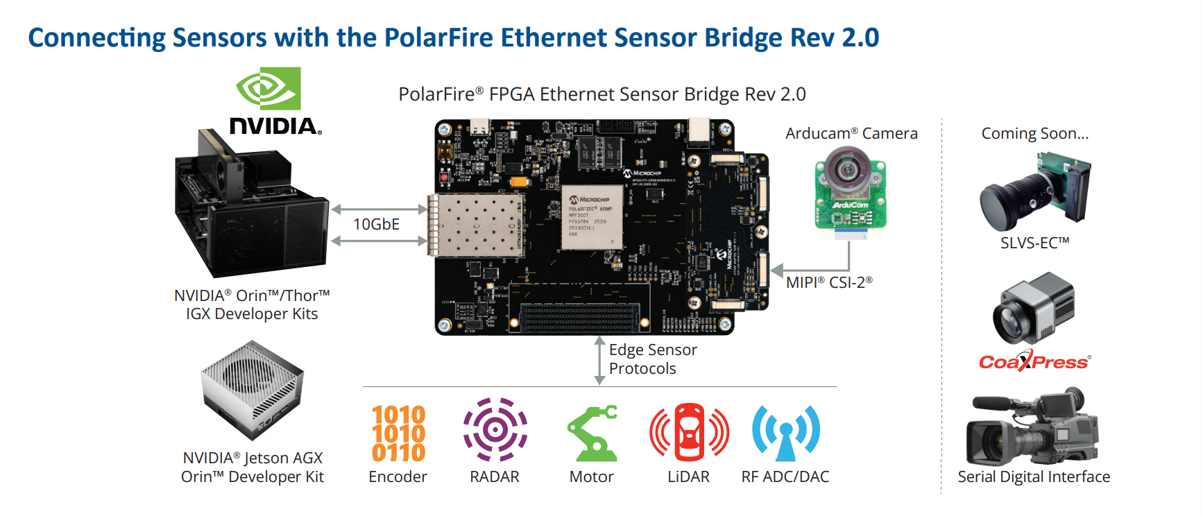
The PolarFire FPGA Ethernet Sensor Bridge platform offers a straightforward answer: use an FPGA to handle real-time preprocessing and data packetization on the sensor side, then use standard Ethernet to send the data into the GPU. Proprietary cables become standard network cables, interface adaptation becomes IP configuration, and sensors and computing units are decoupled from this point forward.
II. Product Overview: Core Specifications at a Glance
Item | Specification |
|---|---|
Core Device | PolarFire® MPF200T FPGA |
Sensor Interface | Up to four MIPI® CSI-2® cameras (Base kit includes one camera) |
Network Uplink | Two 10 GbE SFP+ Ethernet ports |
On-board Memory | 2 GB DDR4 |
Platform Compatibility | NVIDIA IGX, Thor, and Jetson AGX Orin development kits; adds native Jetson connector, factory pre-programmed |
Software Ecosystem | NVIDIA Holoscan Sensor Processing Platform and Holoscan Sensor Bridge SDK v2.5.X |
Expansion Capability | FMC expansion connector for future interfaces such as SLVS-EC™, SDI, HDMI, and DisplayPort™ |
Measurable Latency | On-board delay measurement circuit + Holoscan Sensor Bridge IP timestamps, supporting end-to-end latency verification |
Power Characteristics | Low-power architecture based on PolarFire FPGA, suitable for power-sensitive edge systems |
Development Evaluation Board Model | MPF200-ETH-SENSOR-BRIDGE-R2 |
III. Six Key Points
Four MIPI CSI-2 Inputs: Moving from Monocular Verification to Multi-View Perception
Rev 2.0 supports up to four MIPI CSI-2 cameras, directly covering mainstream architectures like stereo vision, sensor fusion, and multi-view perception. For algorithm teams, this means they can achieve a smooth evolution from monocular prototypes to multi-camera systems on the same hardware, without needing to swap bridge solutions halfway through.
60% Smaller Size: Truly Fits Inside Robot Bodies
Compared to the first-generation platform, the form factor of Rev 2.0 is reduced by 60%. For humanoid robots, AGVs, and handheld medical devices where joint space is tight, size is not about "looking good," but about "whether it can fit." The more compact board profile also leaves greater margins for overall mechanical structural and thermal design.
Native Jetson Connector + Factory Pre-Programming: Minimizing Out-of-the-Box Time
The platform is pre-programmed for NVIDIA IGX, Thor, and AGX Orin development kits, and provides native Jetson connector support. Developers no longer need to waste time on adapter boards, pin assignments, and compatibility lists. Plug it in, connect to the network, and run the pipeline—integration risk is minimized on day one.
Deterministic Low Latency, and It Can Be Measured
Real-time systems fear "roughly fast." This platform uses the PolarFire MPF200T FPGA to complete real-time preprocessing and packetization of sensor data, providing a deterministic data path via Ethernet. Combined with the on-board delay measurement circuit and Holoscan Sensor Bridge IP timestamps, it enables the GPU to read timing information and precisely verify end-to-end latency from sensor acquisition to inference execution. Performance is no longer just a marketing claim, but reproducible data.
Low-Power PolarFire Architecture: The Invisible Dividend of Edge Deployment
Sensor bridges often operate 24/7, and power consumption directly translates to thermal design and battery life pressure. The low-power characteristics of the PolarFire FPGA keep the preprocessing and packetization stages highly energy-efficient, leaving a valuable power budget for embedded vision, robotics, and other power-sensitive scenarios.
FMC Expansion: One Investment Covers Future Interfaces
The platform adds an FMC expansion connector, enabling expansion to interfaces like SLVS-EC, SDI, HDMI, and DisplayPort without redesigning the core platform. Support for protocols such as CoaXPress®, SLVS-EC, SDI, and JESD204B is also currently in development. Today’s selection won't become obsolete due to tomorrow’s sensor upgrades.
IV. How Data Flows
Acquisition: MIPI CSI-2 cameras connect to the bridge platform with up to four parallel inputs.
Processing: The PolarFire MPF200T FPGA performs real-time preprocessing and data packetization.
Transmission: The packetized data is sent via dual 10 GbE SFP+ Ethernet to the NVIDIA developer platform.
- Inference: Data enters the NVIDIA Holoscan pipeline, completing AI processing alongside Holoscan Sensor Bridge SDK v2.5.X. Timestamps support latency measurement and performance verification.
Once this link—"Sensor — FPGA — Ethernet — GPU"—is standardized, sensor replacement, quantity adjustment, and algorithm iteration can all be completed within the same architecture.
V. Deployment Scenarios
- Robotics and Humanoid Robots: Four cameras and a compact board fit the tight spaces of heads and torsos, while low-latency links support real-time motion control and obstacle avoidance.
Industrial Automation and Machine Vision: Multi-camera synchronous acquisition combined with deterministic transmission meets the strict pacing and stability requirements of assembly line inspection.
Automotive and Autonomous Perception: Multi-view, low-latency sensor ingestion and fusion capabilities serve the development and verification of autonomous perception systems.
Medical Imaging: Compact size and low-power characteristics adapt to the development of mobile, long-working-hour imaging equipment.
Smart Infrastructure and Video Analysis: Replacing proprietary cabling with Ethernet facilitates multi-point deployment and long-distance centralized processing.
VI. Why Choose a Proven End-to-End Solution
- 60% smaller than the previous generation with native Jetson connection capabilities for easier embedded integration.
Proven end-to-end solution helps lower integration risks, shorten development time, and reduce total system costs.
Supports up to four cameras with future interface expansion possible via FMC; the base kit already includes one camera.
Built on the PolarFire FPGA, providing deterministic, low-power sensor processing capabilities.
On-board latency measurement functionality helps verify whether real-time performance meets design specifications.
" If your team is repeatedly reworking multi-camera connections, proprietary interface adaptations, or real-time verification, the PolarFire FPGA Ethernet Sensor Bridge Platform Rev 2.0 is worth putting on your next evaluation list: it turns sensor integration from a "project risk" into "standard procedure. "
VII. Get Started Immediately
- or answers and support alignment: Send an email to owenz@macnica.com
For solution guides and application notes: Visit the Microchip Ethernet Sensor Bridge Page.
To order the PolarFire® MPF200T FPGA and MPF200-ETH-SENSOR-BRIDGE-R2 development evaluation board: Send an email to andyn@macnica.com
Data Source and Notes: The technical information in this article is compiled and written based on Microchip's PolarFire FPGA Ethernet Sensor Bridge for NVIDIA, Revision 2.0 (Document Number DS00005691B, August 2026), without introducing performance parameters and actual measurement data outside of this document.

Links
Copyright 2026 Macnica Galaxy International Limited