
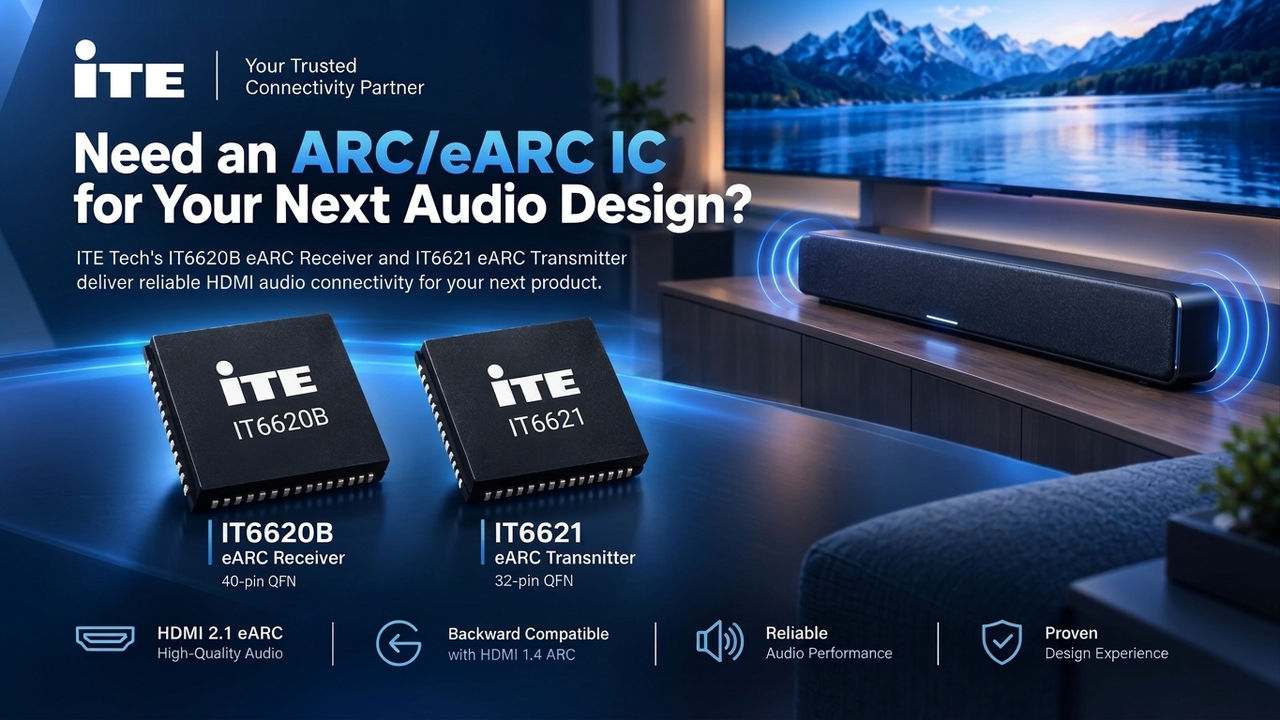
HDMI ARC/eARC is a key interface between TVs and audio systems in soundbars, home theater products, AV receivers, and other HDMI audio devices. When an existing solution is affected by lifecycle changes, longer lead times, or supply continuity requirements, early technical evaluation can provide greater flexibility for production and long-term maintenance. ITE's IT6620B and IT6621 address the eARC receiver and transmitter sides respectively and can be considered for design continuity, alternative-source planning, and new product development.
1 Why early solution evaluation matters
- Supply and lifecycle: Review availability, lead time, and lifecycle status to maintain flexibility for production and long-term support.
- Audio interfaces: Confirm compatibility with existing I²S, S/PDIF, TDM, DSD, and channel configurations.
- ARC and eARC requirements: Define the required return-channel mode and target audio formats based on the product architecture.
- System integration: Evaluate CEC, audio switching, firmware control, package, and PCB changes as part of the complete migration plan.
2 Product positioning
IT6620B is an eARC receiver designed to receive HDMI ARC/eARC audio and deliver it to a downstream audio processor or host system. It supports I²S, S/PDIF, TDM, and DSD, with up to 16-channel L-PCM, and integrates an audio MUX and CEC PHY.
IT6621 is an eARC transmitter designed to send digital audio over an HDMI ARC/eARC link. It supports I²S, S/PDIF, TDM, and DSD inputs, as well as up to 16-channel L-PCM.
3 Key feature comparison
Item | IT6620B | IT6621 |
|---|---|---|
System Role | ARC/eARC receiver | ARC/eARC transmitter |
HDMI 1.4 ARC | Supported | Supported |
HDMI 2.1 eARC | Supported | Supported |
I²S/S/PDIF/TDM/DSD | Supported | Supported |
Maximum L-PCM layout | 16 Channels | 16 Channels |
Audio MUX | Integrated | Not applicable |
Package | 40-pin QFN 5 × 5 mm | 32-pin QFN 4 × 4 mm |
The table provides a functional summary and does not imply a direct pin-to-pin replacement. Actual implementation must be reviewed against the existing pinout, peripheral circuit, firmware, audio formats, and overall system architecture.
4 Target products and applications
- Soundbars and TV audio systems
- Home theater systems
- AV receivers
- HDMI audio processing equipment
- Consumer electronics requiring ARC/eARC audio return
5 How to start the technical evaluation
If a project is affected by an end-of-life notice, extended lead time, supply adjustment, or a new-generation design plan, the following information can help accelerate evaluation:
- Current system block diagram and complete device part number
- Current use of ARC or eARC
- Audio input/output interfaces, channel count, and target formats
- Existing PCB, peripheral circuitry, and firmware control method
- Target production schedule and supply requirements
ITE and Macnica Anstek can help evaluate the suitability of IT6620B or IT6621 for specific applications.
- Technical inquiries and product information: (ITE):op1sales@ite.com.tw
- Quote, Evaluate(Macnica Anstek):marketing.anstek@macnica.com