
Tiny FPGAs Making a Big Difference in Wearables
As wearable technology becomes more intelligent, compact, and always-on, the demands placed on hardware design are growing exponentially. Consumers expect sleek, lightweight devices that deliver real-time insights without draining the battery. And engineers are tasked with building those experiences within extremely constrained power and space budgets.
This is where Lattice Semiconductor’s low power FPGAs shine.
Rethinking Wearable Design with Edge Intelligence
Today’s wearables are no longer passive trackers — they’re active companions. Whether it's counting reps at the gym, recognizing gestures to control music, or aggregating sensor data for continuous health monitoring, real-time processing at the edge is essential.
But traditional processors alone can’t keep up — not without compromising battery life or responsiveness. Lattice’s FPGAs provide a solution: enabling smarter, always-on functionality directly within the device.
Why FPGAs for Wearables?
Lattice FPGAs bring three key advantages to wearable product design:
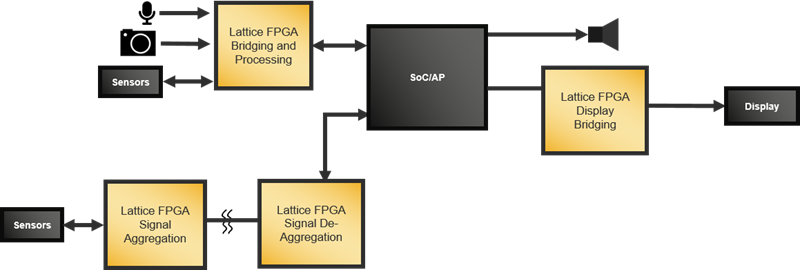
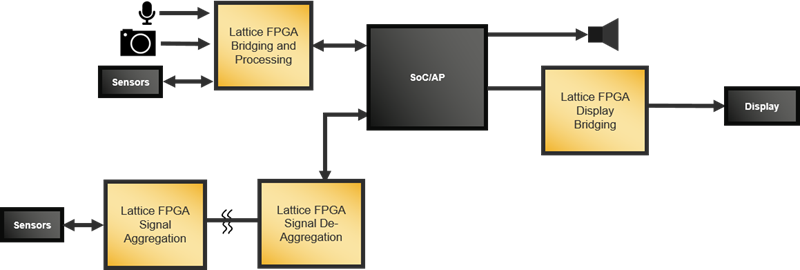
- On-device AI for real-time object detection, gesture recognition, or activity classification — with no need to wake a power-hungry host processor.
- Flexible I/O and sensor aggregation, perfect for fusing data from multiple sources like accelerometers, gyros, ambient light sensors, or microphones.
- Compact form factors and low power profiles, making them ideal for watches, hearables, fitness trackers, and more.
Let’s take a closer look at two common use cases where Lattice’s iCE40 UltraPlus makes a big difference.
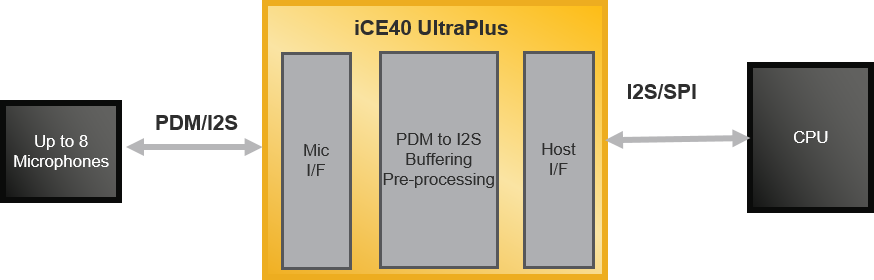
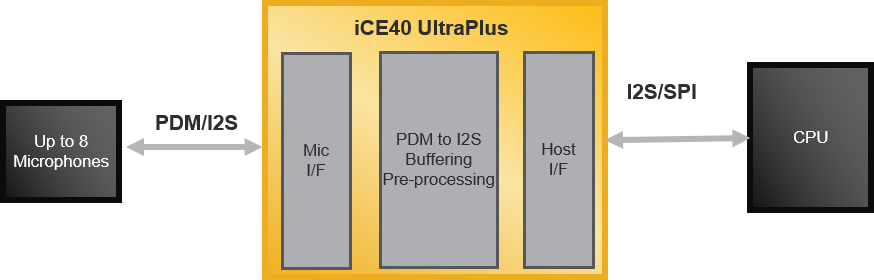
2. Audio Bridging for Voice-Enabled Devices
Voice is fast becoming a key interface in wearables — from fitness assistants to voice notes on-the-go. But supporting multiple microphones or complex audio paths can overwhelm the system processor.
With iCE40 UltraPlus, developers can:
- Connect up to 8 PDM or I2S microphones.
- Buffer and pre-process audio data using up to 1 Mb of on-device RAM.
- Offload audio tasks from the processor, improving responsiveness and power efficiency.
This makes voice-activated features not only possible, but practical, even in small and affordable wearables.
The Right FPGA for Every Wearable Design
While iCE40 UltraPlus is perfect for ultra-compact, sensor-rich devices, other Lattice FPGAs offer complementary benefits:
- CrossLink-NX™ for high-performance camera or sensor interfacing — ideal for computer vision wearables or smart glasses.
- MachXO™ family for secure, reliable control logic and I/O expansion in wearables that require robust system management.
Together, these devices form a flexible FPGA portfolio that addresses the full spectrum of wearable design challenges— from prototyping to mass production.
As the official distributor of Lattice Semiconductor in Europe, Macnica Europe helps device makers and engineering teams turn bold ideas into working products — with local technical support, deep FPGA expertise, and access to the Lattice portfolio.
Whether you’re building your next prototype or scaling to production, we’re here to help.
Ready to accelerate your wearable roadmap? Contact us to start the conversation.