



How to Select Edge AI Hardware for Smart Factory Applications
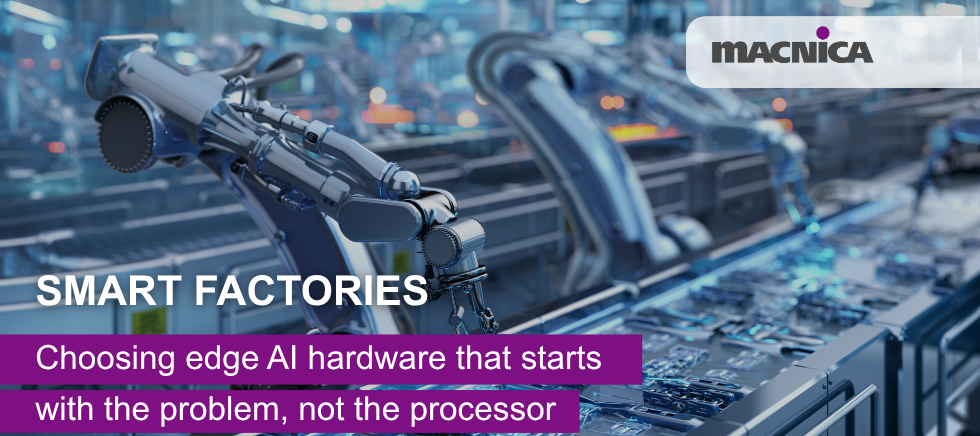
Artificial intelligence is moving closer to where manufacturing actually happens. Instead of sending data from factory equipment to a remote cloud platform or relying on powerful centralized GPU servers, manufacturers can increasingly run AI inference directly alongside cameras, sensors and production machinery in their factories.
This shift has been enabled by increasingly capable, lower-power AI accelerators and system-on-chip (SoC) devices. At the same time, more open software development kits (SDKs) are making it easier to deploy custom models without being tied to a single proprietary hardware ecosystem.
But the expanding choice creates another problem: how does a manufacturer decide what edge AI hardware it needs? The answer should start with the manufacturing problem rather than the processor, and where the most immediate benefit can be found. A successful edge AI deployment needs to consider the complete chain from capturing data, through processing it, to communicating results to the rest of the factory. Just as importantly, it needs to provide a route from an initial deployment to wider adoption without requiring existing production infrastructure to be completely re-engineered.
Start with a problem that delivers measurable value
For manufacturers introducing edge AI for the first time, the process starts with capturing useful visual data, and outgoing quality control (OQC) can provide a logical starting point with the most immediate benefits. Quality problems have a direct financial impact. Poor yield creates waste, while defects that reach customers can lead to returns, warranty claims and potentially more serious liabilities. Automating part of the inspection process therefore provides an application where the return on an AI investment can be relatively easy to identify.
Automated inspection systems can replace many manual alternatives, making huge savings. There will be an initial outlay, but there can be a substantial return on investment in two years or less. After initial setup, adding further lines can be cheaper too.
However, OQC illustrates why selecting edge AI hardware should not begin by comparing processor specifications. The first question is what needs to be detected. A camera operating in visible light might be sufficient for one inspection process, while another could require infrared, shortwave infrared or X-ray sensing. Multiple sensor types could also be combined where higher accuracy is required.
Even relatively simple applications can benefit from AI. A beverage production line, for example, might use a camera to assess the color of a drink to determine whether its concentration is correct. A food manufacturer looking for foreign material inside a product could require a very different combination of sensing technology and illumination.
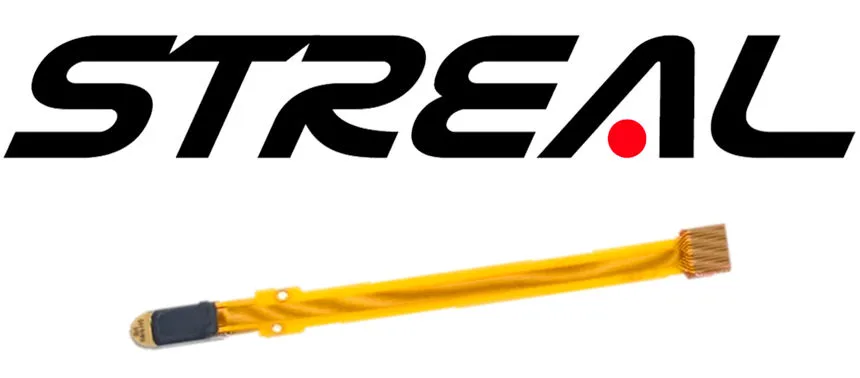
Not every measurement will be visual. STREAL is Macnica’s range of compact semiconductor strain sensors for measuring force, load and torque with high precision. Embedded in robots, machinery or structures, they enable real-time motion control, quality monitoring and predictive maintenance. Low-power and high-resolution models allow manufacturers to add intelligent sensing to existing equipment with minimal redesign.
In practice, determining the correct sensing technology will require testing with actual products under real production conditions. This makes data capture the first major hardware decision.
Bring processing closer to the process
Once data has been captured, manufacturers need to decide where it should be processed. Edge computing can encompass a wide range of environments. Inference might take place inside a smart camera, perhaps using an Ambarella or Analog Devices processor. It could be performed on a module beside a conveyor belt or in an industrial PC controlling a machine, or in a local server handling feeds from multiple cameras, powered by DeepX AI accelerators.
Processing close to the source provides two particularly important advantages for industrial applications: low latency and security. An automated production process may need to respond to an inspection result almost immediately. Sending sensor data across a network to the cloud, waiting for inference and returning the result introduces delays and network dependencies that local processing can avoid.
Keeping processing on premises can also help manufacturers retain control of sensitive information about their products and production processes. Data, software and algorithms can remain within the factory rather than routinely being transferred to an external cloud service. Data and AI sovereignty are increasingly in focus, and keeping important intellectual property local can hugely help with this.
Match compute performance to the workload
Edge AI does not necessarily require the largest or fastest processor available.
Many industrial applications are highly focused. A system may need to recognize a particular manufacturing defect, classify a component or determine whether an object is positioned correctly. It does not need the computational resources required by a large general-purpose AI model.

Advances in dedicated AI accelerators and SoCs have made it possible to run real-time computer vision models such as You Only Look Once (YOLO) directly on edge devices. This is creating alternatives to the relatively expensive, power-hungry GPU hardware that previously dominated many AI deployments.
Depending on the application, manufacturers can now choose between AI-enabled SoCs, dedicated neural processing units, FPGA-based acceleration and discrete accelerator cards. Suppliers including Altera, Analog Devices, Ambarella, DeepX, Connect Tech and TQ provide different approaches to bringing this processing capability closer to industrial equipment.
The selection criteria therefore need to extend beyond headline AI performance. Power consumption and heat dissipation can be particularly important inside industrial equipment. Physical form factor, sensor interfaces, supported AI models, latency and cost must also be considered. The objective should be to provide sufficient inference performance for the application without paying for unnecessary compute capacity.
Software matters as much as silicon
The hardware specification is only part of the decision. Manufacturers should also consider the software ecosystem surrounding the processor. Historically, using GPUs for AI could create considerable dependence on the associated software environment with one vendor dominating the ecosystem. Changing processor architecture could consequently require significant redevelopment.
The growth of accelerators supporting open SDKs and commonly used model formats is increasing the available choice. Tools such as ONNX Runtime, OpenVINO and Apache TVM allow developers to optimize and deploy computer-vision models across a broader range of edge hardware, while accelerator vendors increasingly provide SDKs capable of importing models developed using widely adopted frameworks. Manufacturers can potentially train their own models and deploy them across lower-cost, lower-power hardware without becoming as dependent on a particular processing platform.
This makes model portability an important hardware-selection criterion. Manufacturers should ask whether existing models can run on the platform, how difficult they will be to migrate in the future, and whether the hardware and SDK give them sufficient control over their own models and data. In fact, the model and the data used to train it may ultimately provide more competitive differentiation than the processor itself.
Two factories could use similar cameras and identical AI accelerators but achieve significantly different results because one has better training data and a more accurate model. Proprietary datasets generated from real production processes can therefore become valuable intellectual property. Getting this element right means working with the right ecosystem partners to develop the perfect configuration for your business’s use case.
Scale without rebuilding the factory
Hardware selection also needs to take account of the unusually long lifecycle of industrial equipment. Factories cannot replace production lines every time a new generation of AI accelerator arrives. Many automation systems remain operational for a decade or considerably longer, making integration with existing infrastructure essential.
Fortunately, edge AI can sometimes be added incrementally. An existing inspection system might be enhanced by installing additional cameras and adding local AI processing. Industrial PCs can also gain AI capabilities through accelerator cards using familiar PCIe or M.2 interfaces, allowing inference workloads to be offloaded to newer processors without replacing the complete control system. This approach provides manufacturers with a relatively low-friction way to trial edge AI before committing to a larger deployment.
Not every application will be so straightforward. Some production processes will require a more tightly integrated system, while turnkey AI installations supplied by system integrators may be highly customized and difficult to transfer to other lines. Scalability therefore needs to be considered during the initial hardware decision rather than after a successful proof of concept. Edge AI should be specified to scale from the outset.
From quality control to the smart factory
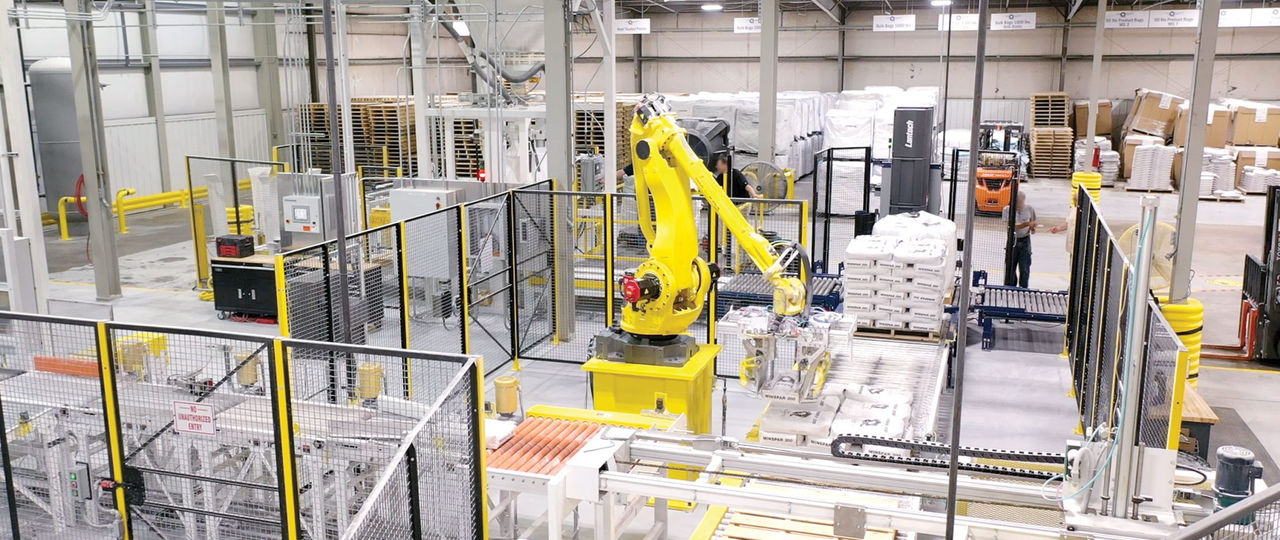
Once an initial application demonstrates a return, the same principles can be extended elsewhere, communicating the benefits to other parts of the business. Outgoing quality control can be followed by incoming quality control, allowing manufacturers to identify defective materials or components before they enter production. AI can assist robotic assembly and process optimization, while computer vision can monitor whether employees are using appropriate personal protective equipment (PPE).
As the number of applications grows, connectivity becomes increasingly important. Reliable industrial networking from suppliers such as Silex and Infineon can connect sensors, edge processors and existing factory systems while allowing AI capabilities to be distributed across multiple production lines.
The result does not need to be a single, monolithic factory AI platform. It can instead be an architecture in which sensing, processing and communications capabilities are added where they provide measurable value. Choosing edge AI hardware is consequently less about identifying the most powerful accelerator than finding the appropriate combination of technologies for a specific manufacturing problem.
Manufacturers can start with a narrowly defined application such as OQC, select the sensors and processing hardware needed to solve it, and then build outwards. Prioritizing modular hardware, open software environments and model portability can allow that first deployment to become the foundation for much broader factory AI adoption. The principle is simple: start small, but don't design small.
Macnica Americas Site Map


©Copyright 2026 Macnica Americas, Inc.