



Importance of Diversity
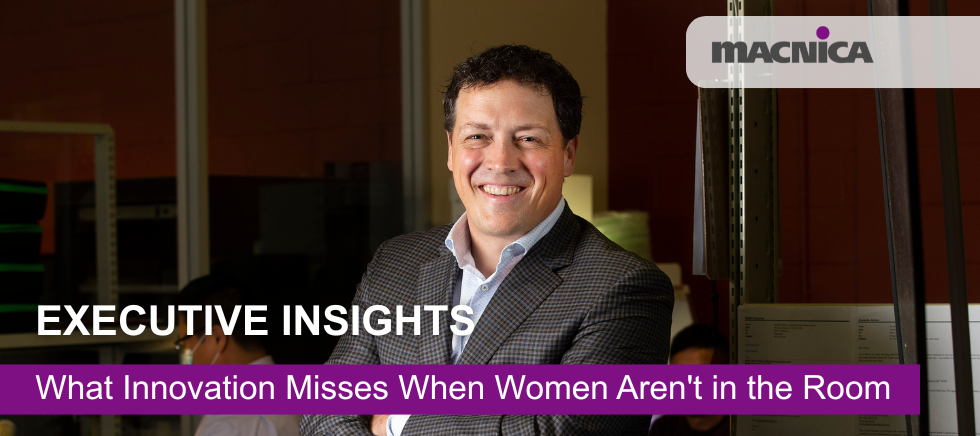
What Innovation Misses When Women Aren't in the Room
Why increasing the number of women in technology isn't just about representation. It's about building better products, better companies and a better future.
I am the proud father of two daughters.
My oldest recently won a gold medal at Volleyball Nationals within her division. My youngest stepped far outside her comfort zone and entered the world of competitive dance, where she has consistently placed with her tap solo and with her group dances.
Watching them pursue their goals reminds me that confidence grows when people believe opportunities are available to them.
Like most parents, I spend a lot of time thinking about their future. Will they find careers they love? Will they have opportunities to succeed? If they work hard, will they have the same chances as everyone else?
Those questions matter because I know firsthand that opportunities are never guaranteed.
I grew up in a modest blue-collar French-Canadian family outside Quebec, where Franco-Ontariens are considered a minority group. We fought hard for equal opportunities just as our ancestors fought to keep the language and culture alive and well. That fighting spirit has stayed with me throughout my life and career.
Learning the Importance of Diversity at an Early Age
At 16, I learned many of my earliest business lessons while managing a local pizzeria. Later, I studied in an international business program that brought together students from different countries, cultures and backgrounds to learn from one another and prepare for leadership in an increasingly connected world.
Diversity wasn't treated as a social initiative. It was taught as a business advantage. And throughout my career, I continue to apply that lesson.
Today at Macnica, I see that strength every day. Our engineering teams represent dozens of cultures and nationalities. In a single meeting, you might hear multiple accents, perspectives and approaches to solving the same problem.
Different backgrounds. Different experiences. Different ways of thinking. All working toward a common goal.
A Comment That Changed My Perspective
A few weeks ago, I posted a photograph on LinkedIn celebrating an award won by our FPGA team.
It was a proud moment.
The team had worked incredibly hard and deserved the recognition. Looking at the picture, I saw a highly diverse group of professionals representing a wide range of cultures and backgrounds.
I was proud of what the team had accomplished. Then a comment appeared.
"Shame there aren't any women on the team."
My first reaction was frustration. The comment felt unfair.
How could someone make that judgment based on a single photograph? How could one moment in time erase years of effort spent building diverse and inclusive organizations?
But the more I thought about it, the more uncomfortable I became. Not because the comment was entirely accurate. But because it wasn't entirely wrong either.
The photograph was real. The observation was real.
And while there is always context behind every picture, the reality is that technical fields such as engineering, semiconductors, FPGA development and advanced computing continue to struggle with female representation.
The commenter had reduced an entire organization to a single image.
But perhaps I had become too comfortable viewing diversity through a wider lens.
While I was celebrating ethnic, cultural and international diversity, someone else was looking at the same image and seeing a different challenge altogether.
That realization stayed with me. It reminded me that diversity is not a scorecard. It is not a destination. It is not something we achieve once and then declare victory. It is an ongoing responsibility and opportunity.
Especially when it comes to bringing more women into technology.
The Cost of Missing Perspectives
That experience forced me to ask a difficult question. What are we missing when important perspectives aren't represented?
Throughout history, many of the world's greatest innovations have emerged when people with different experiences, expertise and viewpoints came together to solve problems.
Innovation happens when different perspectives collide.
People with different backgrounds often identify needs others overlook. They uncover new applications, discover underserved markets and challenge assumptions that have gone unquestioned for years.
That is why diversity matters. Not because it’s perceived as fair. But because it makes innovation better.
Leaving Talent, Creativity and Insight on the Sidelines
According to the U.S. Bureau of Labor Statistics and the National Center for Women & Information Technology, women represent approximately 47% of the U.S. workforce. Yet they hold only about 26% to 28% of computing and mathematical occupations. In many areas of the technology industry, women account for just 15% to 20% of software developers and engineers.
Think about what those numbers really mean.
If innovation depends on diverse perspectives, then we are leaving an enormous amount of talent, creativity and insight on the sidelines.
The real question is not whether women deserve a seat at the table. Of course they do.
The question is how many opportunities, products and breakthroughs do we miss when they aren't there.
Progress, But More Work Ahead
At Macnica, I am proud of the diverse teams we have built and the opportunities we have created for people from many different backgrounds.
I am proud that our teams span countries, cultures and experiences. I am proud that we help bring technology to every corner of the world.
But on a broader level, I also recognize that our industry still has work to do when it comes to increasing the representation of women in technology.
Around the world, organizations such as Women in Technology, Women Who Code, Girls Who Code, and the Society of Women Engineers are helping create pathways for the next generation of innovators. Countries including Canada, the United Kingdom and Sweden continue investing in programs designed to increase participation in STEM careers.
These efforts matter. Not because they help one group succeed. Because they help all of us innovate better.
When more women enter engineering, software development, cybersecurity, artificial intelligence and business leadership, we gain new perspectives, new ideas and new ways of solving problems. And that benefits everyone.
The Future Depends on It
One LinkedIn comment did not erase the progress we have made. But it reminded me that progress is not the same thing as completion. There is still work to do. There are still barriers to remove. There are still opportunities to create and innovate.
And when I look at my daughters, I am reminded why that work matters. I want them to enter a world where opportunity is determined by talent, curiosity and ambition.
I want them to see engineers, entrepreneurs, scientists and business leaders who look like them. I want them to believe that every door is open if they work hard enough. Most importantly, I want them to know that their ideas matter.
Because the future of innovation will not be built by technology alone. It will be built by people. And the more voices we invite into the conversation, the better that future will be.
Unfortunately, the technical sales professional who made the original comment has since deleted it. If she is reading this today, I want her to know that she had every right to make that observation and she had every right to challenge today’s business leaders to do more.
I believe most business leaders and entrepreneurs rise to the occasion especially when positive outcomes, growth and innovation collide.
Macnica Americas Site Map


©Copyright 2026 Macnica Americas, Inc.