



Where Robot Intelligence Lives
Choosing the Right Processing Architecture for Robotics
Every robotic system operating in the physical world must capture information from sensors, process that information into decisions, and communicate those decisions to actuators, operators, or connected systems. Of these three functions, the processing architecture determines achievable latency, throughput, determinism, power consumption, thermal ceiling, software flexibility, and the system's ability to absorb new algorithms over a product lifecycle that may span a decade or more.
No single architecture is optimal for every workload. Visual inspection demands deterministic processing with tightly bounded latency at full line speed. Autonomous mobile robots must run continuous perception and path planning while minimizing power draw to extend battery runtime. Surgical robots must isolate safety-certified control from AI inference within strict thermal and regulatory constraints. Each system imposes a different hierarchy of requirements, and the wrong architectural choice creates integration risk that compounds through every subsequent design phase.
CPUs, GPUs, FPGAs, NPUs, MCUs, and AI vision SoCs each process data through different compute fabrics with distinct tradeoffs in parallelism, determinism, programmability, and power efficiency. In most robots, the optimal architecture is multiple processing engines with workloads partitioned by latency, throughput, and safety requirements.
This article explains how six processing architectures work at the hardware level, compares their engineering tradeoffs, maps each to the robotics applications where it delivers the strongest advantage, and identifies the hybrid combinations that production deployments require.
How Each Architecture Works
The performance characteristics that matter in robotics, including latency, power efficiency, determinism, and flexibility, are direct consequences of how each architecture moves data through its compute fabric.
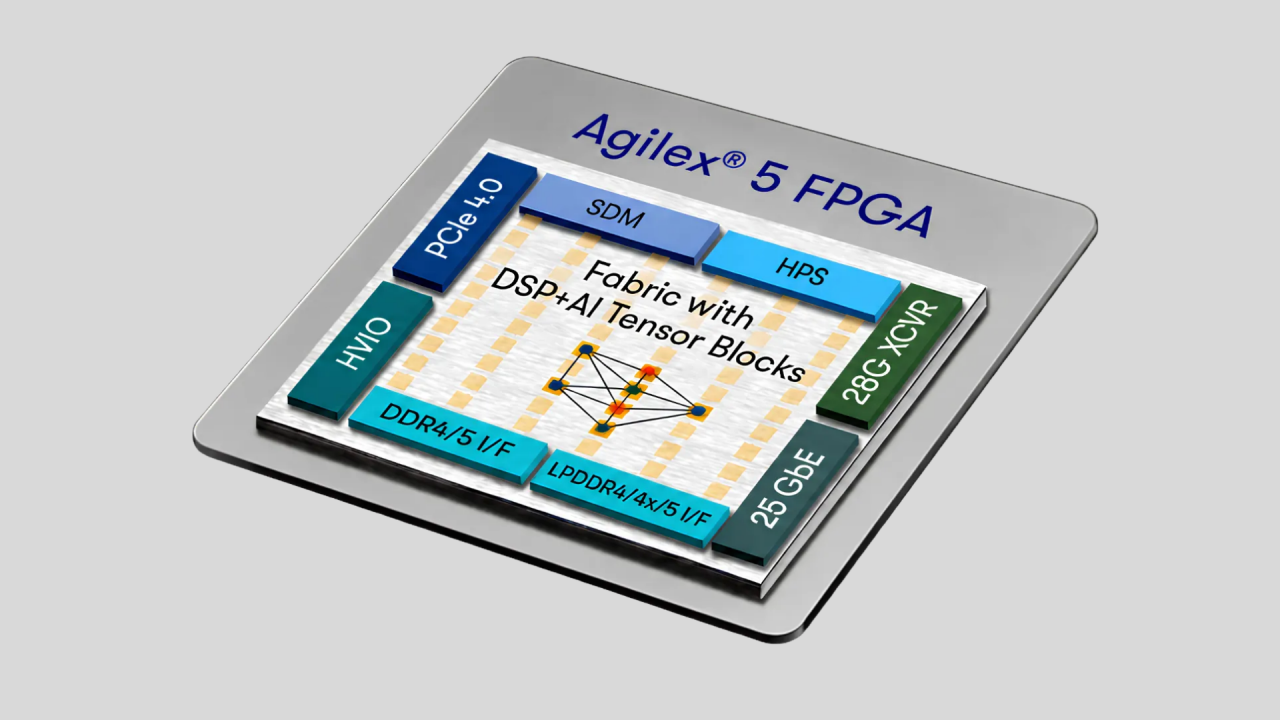 Figure: Agilex 5 FPGA D-Series devices for high performance, low power, and small form factors
FPGA: Configurable Hardware Fabric
An FPGA is not a processor in the conventional sense. It is a grid of programmable logic blocks, each capable of implementing arbitrary Boolean functions, connected through a configurable routing network. Engineers describe the desired behavior in a hardware description language (Verilog or VHDL), and the FPGA’s configuration memory maps that description directly onto physical logic gates and interconnects. The result is a custom hardware circuit that executes in parallel, with data flowing through pipeline stages on every clock cycle.
This architecture delivers deterministic latency because there is no instruction fetch, no cache miss, no OS scheduler, and no bus arbitration competing for execution time. A sensor data sample entering the FPGA fabric exits as a processed result after a fixed number of clock cycles later, every time, regardless of system load. Modern FPGA SoCs add integrated Arm application processors alongside the programmable fabric, allowing designers to run Linux, ROS2, and higher-level software on the CPU cores while keeping timing-critical operations in hardware. For example, Altera’s Agilex 5 combines quad-core Arm Cortex-A76/A55 processors with AI-optimized tensor blocks, LPDDR5/DDR5 memory interfaces, transceivers up to 28.1 Gbps, and PCIe Gen 4. The Agilex 3 provides a cost-optimized and power-optimized alternative for compact edge deployments.
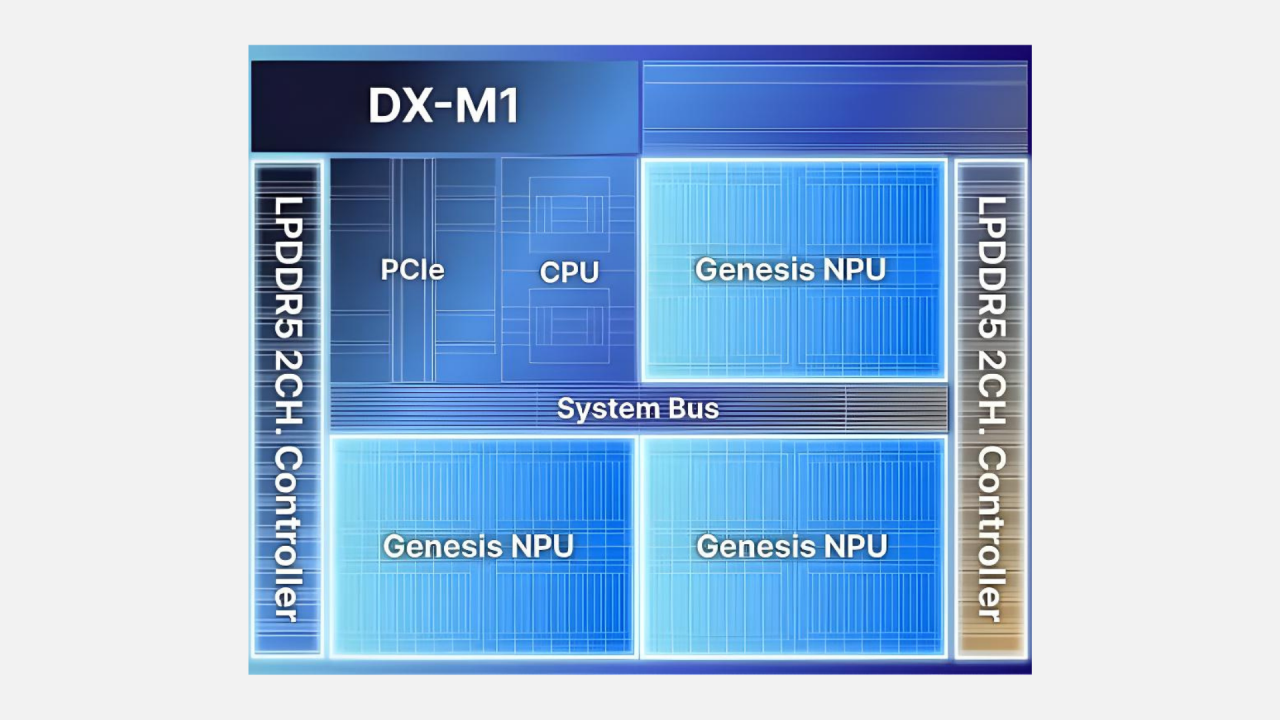 Figure: DEEPX DX-M1 NPU. 25 TOPS at 1 to 5W with concurrent multi-model inference.
NPU: Silicon Optimized for Neural Network Math
A neural processing unit (NPU) is an ASIC (application-specific integrated circuit) designed around a single class of workload – the matrix multiply-accumulate operations that constitute the core computation in neural network inference. Where a CPU executes one instruction at a time across general-purpose ALUs and a GPU executes thousands of threads in lockstep across SIMD (single instruction, multiple data) cores, an NPU organizes its compute fabric as a dense array of multiply-accumulate units with dedicated data movement hardware that keeps those units fed without the overhead of a general-purpose memory hierarchy.
The result is extreme inference efficiency measured in TOPS per watt. An NPU achieves this by eliminating the transistor overhead that CPUs and GPUs spend on branch prediction, speculative execution, cache coherence, and thread scheduling, none of which serve any purpose during inference. DEEPX’s DX-M1 delivers 25 TOPS of INT8 inference at 1 to 5 watts in an M.2 2280 form factor over PCIe Gen3 x4. It supports up to 8 GB of LPDDR5 memory, enabling multiple AI models to run concurrently. Independent benchmarking has confirmed approximately 20 times the inference-per-watt efficiency of discrete GPUs. The DXNN SDK supports model deployment from PyTorch, TensorFlow, ONNX, and Keras with automated compilation and optimization for the NPU hardware.
GPU: Massively Parallel Thread Execution
A GPU organizes computation around thousands of lightweight cores grouped into streaming multiprocessors, each executing the same instruction across multiple data elements simultaneously (SIMD). This architecture was originally designed for graphics rendering, where the same shading operation must be applied to millions of pixels per frame. The same parallelism maps naturally onto neural network training and inference, where the same matrix operations must be applied across millions of weight parameters.
GPUs deliver the highest absolute throughput for parallel AI workloads and benefit from a mature software ecosystem (CUDA, cuDNN, TensorRT). In robotics, GPU-based platforms such as NVIDIA Jetson modules are strongest in systems with access to mains power and in applications requiring multi-model inference or training at the edge. The tradeoff is power consumption: Jetson modules draw 5 to 130 watts depending on the variant and performance mode. For battery-powered mobile robots or thermally constrained sealed enclosures, this power draw demands active cooling that adds mechanical complexity, weight, and failure modes.
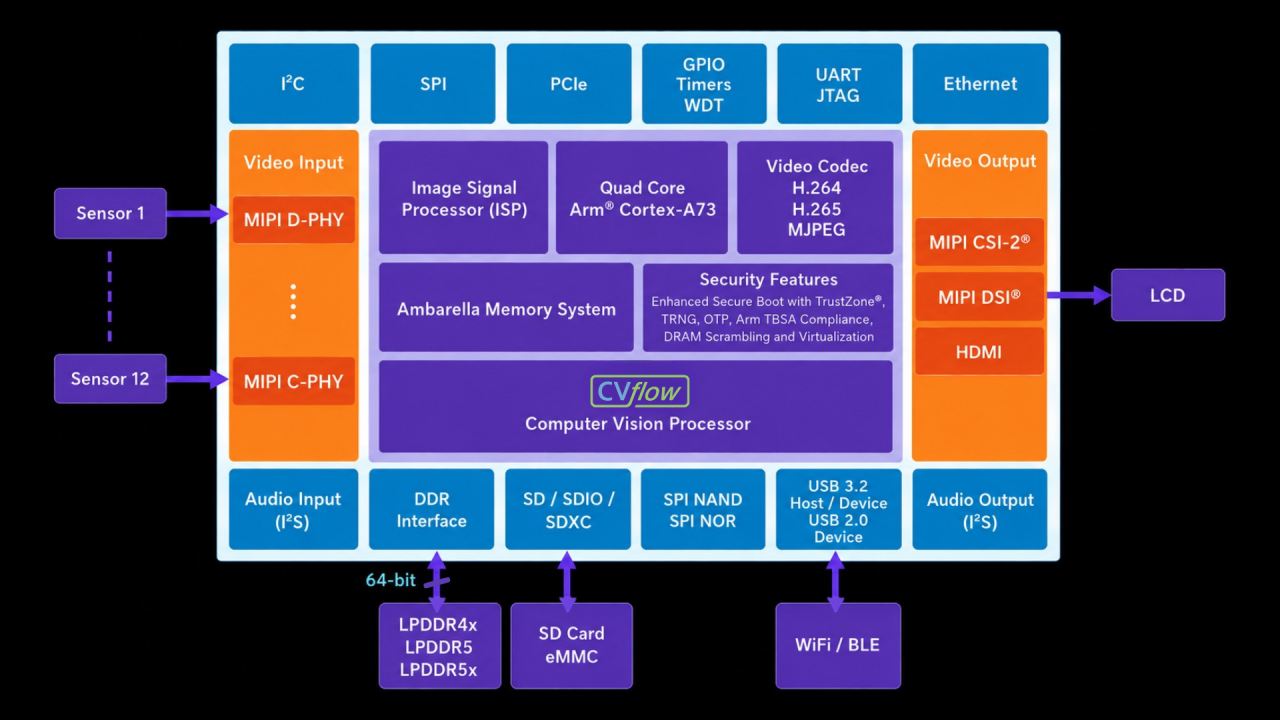 Figure: Ambarella CV7. Edge AI vision SoC with 8K processing and multi-sensor perception.
AI Vision SoC: Integrated Camera-to-Decision Pipeline
An AI vision system-on-chip integrates an image signal processor (ISP), a hardware video encoder/decoder, a dedicated AI inference engine (typically a neural network accelerator with a proprietary architecture), and one or more Arm application processor cores for system management. The key architectural advantage is that data flows between these engines through on-chip interconnects rather than through external buses, eliminating the bandwidth bottlenecks and latency penalties that arise when discrete ISP, encoder, and inference chips must communicate across a PCB.
This integration is most effective when the primary workload is a vision pipeline: camera data enters, gets conditioned by the ISP, analyzed by the AI engine, optionally encoded for storage or streaming, and the inference result triggers a downstream action. Ambarella’s CV7, built on a 4nm process, processes multi-stream video up to 8Kp60 with simultaneous edge AI inference at low power. The CV75S adds vision-language model (VLM) capability, dual Arm Cortex-A76 cores at 1.6 GHz, and USB 3.2 connectivity. The CV72S provides 4Kp60 processing on a 5nm process node with CVflow 3.0 AI architecture, offering the strongest AI performance per watt in its class for mainstream robotics and industrial vision applications.
CPU: General-Purpose Application Processor
A CPU executes instructions sequentially through a pipeline of fetch, decode, execute, and write-back stages. Modern application processors (x86 and Arm Cortex-A class) add branch prediction, speculative execution, out-of-order dispatch, and deep cache hierarchies to maximize single-thread performance on arbitrary workloads. This generality makes the CPU the only architecture that can run a full operating system, manage complex multi-process software stacks, and handle the diverse I/O that robotics systems require: Ethernet for fleet coordination, USB for peripheral management, PCIe for accelerator cards, and storage interfaces for logging and model updates.
In a robotics processing stack, the CPU handles the orchestration layer: ROS2 node execution, path planning algorithms, fleet management coordination, OPC-UA and MQTT communication with enterprise systems, Docker containerization for edge workloads, and the application logic that translates AI inference results into actionable decisions. The CPU is not competitive for sustained AI inference (it lacks the parallel compute density) or for hard real-time control (the OS scheduler introduces non-deterministic latency). Its role is to sit above the FPGA, NPU, and MCU layers, providing the software flexibility and connectivity that those architectures cannot. TQ Systems, iEi, and other Macnica-represented module vendors provide production-ready embedded compute platforms spanning Intel x86 and Arm architectures with industrial temperature ratings, long-life component commitments, and carrier board ecosystems.
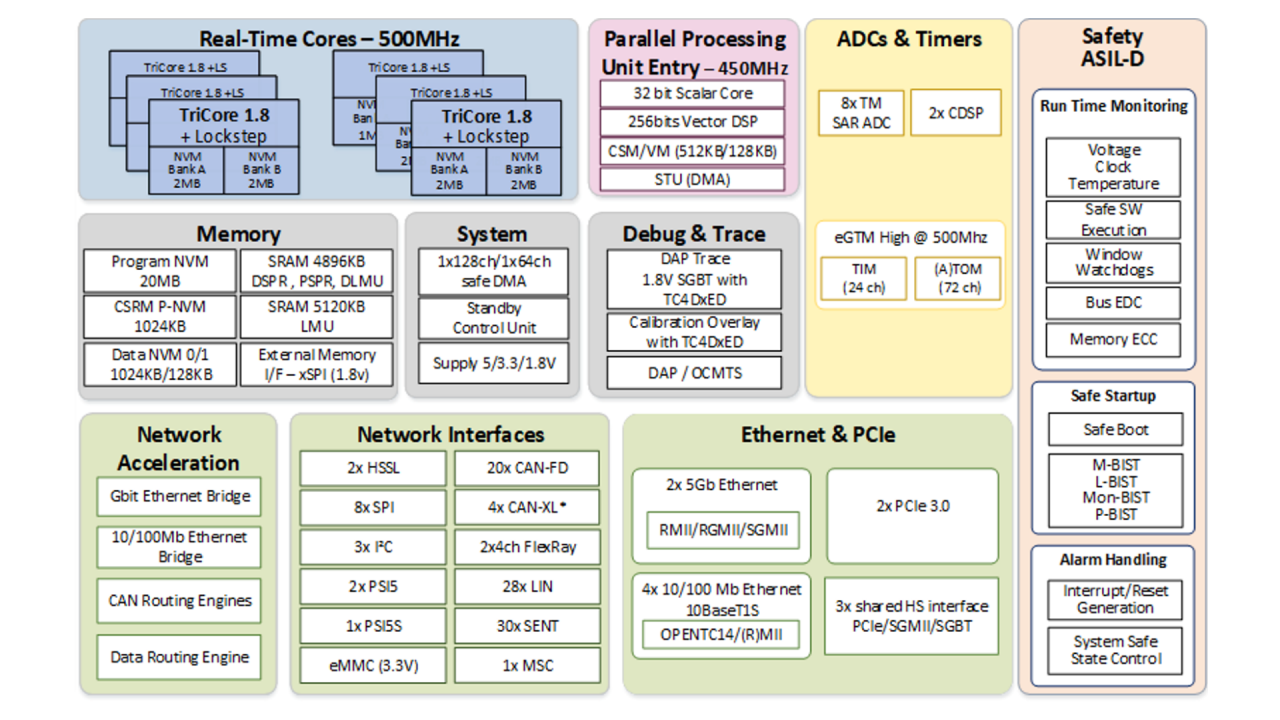 Figure: Infineon AURIX TC4x. Lockstep safety MCU for real-time motor control and functional safety.
Safety MCU: Certified Deterministic Control
A microcontroller is a single-chip system with a CPU core, flash memory, SRAM, and peripheral interfaces integrated on one die. For robotics, the relevant category is safety-certified MCUs designed around the lockstep dual-core architecture required for functional safety standards. In lockstep mode, two identical CPU cores execute the same instructions simultaneously and a hardware comparator checks their outputs on every cycle. Any divergence triggers an immediate fault response, providing the hardware-level error detection that IEC 61508 (industrial) and ISO 26262 (automotive) demand.
Safety MCUs handle motor control algorithms (field-oriented control for brushless DC motors, torque and position loops), functional safety monitoring (emergency stop, watchdog timers, safe torque-off), and deterministic actuator interfaces (PWM generation, encoder feedback, current sensing). Infineon’s AURIX TC4x family provides ASIL-D certification for automotive robotics. The PSoC C3 MCU addresses industrial and healthcare applications where functional safety is mandatory but full automotive-grade certification is not required. These MCUs close actuator control loops in microseconds with hardware-guaranteed determinism, providing the certified foundation that sits beneath all higher-level processing.
Architecture Comparison at a Glance
| FPGA | NPU | GPU | AI Vision SoC | CPU | Safety MCU | |
|---|---|---|---|---|---|---|
| Architecture | Configurable logic fabric + Arm SoC | MAC array ASIC, fixed-function | SIMD cores, parallel threads | ISP + AI + codec + CPU on one die | Sequential pipeline, branch predict, cache | Lockstep dual-core + comparator |
| Latency | µs (deterministic) | Low ms (consistent) | Low ms (variable) | Low ms (pipeline) | ms (OS-dependent) | µs (deterministic) |
| Power | 2–15 W | 1-5 W | 5-130 W | 1–5 W | 5–45 W | 0.5–3 W |
| AI Throughput | AI tensor blocks | 25+ TOPS/chip | Highest absolute | Integrated w/ ISP | Not competitive | None |
| TOPS/Watt | High (tuned) | Highest | Moderate | High | Lowest | N/A |
| Determinism | HW-guaranteed | High | OS-dependent | Pipeline-level | Non-deterministic | HW-guaranteed |
| SW Flexibility | HDL + Arm SDK | Model-agnostic SDK | Full CUDA ecosystem | Vision-scoped | Full OS, any language | Bare-metal / RTOS |
| Best Fit | Sensor fusion, preprocess, real-time | Edge inference, battery systems | Prototyping, mains power | Camera-first, video analytics | Orchestration, fleet, ROS2 | Motor control, safety loops |
| Featured Macnica offerings | Altera Agilex 5, Agilex 3 | DEEPX DX-M1 | Connect Tech Jetson carriers | Ambarella CV7, CV75S, CV72S | TQ Systems, iEi x86/Arm SoMs | Infineon AURIX, PSoC C3 |
The Right Architecture Is Usually Heterogeneous
No production robotics deployment runs on a single processor type. The question is not which architecture to choose, but how to partition workloads across architectures so that each subsystem operates within its optimal performance and power envelope. The table below maps common robotics workloads to the processing options that satisfy each workload's primary requirement.
| Workload | Primary Requirement | Common Processing Options |
|---|---|---|
| Camera acquisition | High bandwidth, synchronization | FPGA, Vision SoC |
| Image conditioning | Streaming throughput, low latency | ISP, FPGA, Vision SoC |
| AI inference | Parallel tensor processing | NPU, GPU, FPGA |
| Point-cloud processing | Parallel compute, memory bandwidth | GPU, CPU, FPGA |
| SLAM and localization | Flexible compute, acceleration | CPU, GPU, SoC |
| Path planning | Software flexibility | CPU |
| Motor control | Deterministic real-time response | MCU, FPGA |
| Safety monitoring | Predictable execution, independence | Safety MCU, FPGA |
| ROS 2 and middleware | General-purpose processing | CPU |
| System management | Software flexibility | CPU, MCU |
| Industrial networking | Deterministic communication | MCU, FPGA, CPU |
In most production systems, several of these workloads run concurrently, which is why the processing stack requires multiple architectures operating in parallel. Four questions guide the partitioning:
1. What must happen deterministically?
Control loops, safety responses and sensor synchronization may require bounded latency. These workloads often favor MCUs or FPGA logic rather than a general-purpose operating system.
2. What requires massive parallel processing?
Computer vision, neural networks, point clouds and image pipelines can benefit from GPUs, NPUs, FPGA acceleration or dedicated vision processors.
3. What must run in software?
ROS 2, navigation, application logic, device management and networking generally need a CPU with the appropriate operating-system and software ecosystem.
4. What are the power and thermal limits?
A stationary industrial robot connected to facility power can make different compute choices than a battery-operated AMR, drone or portable healthcare robot.
Macnica’s Processing Portfolio
Macnica represents technology suppliers spanning FPGAs and SoC FPGAs, NPUs and AI accelerators, AI vision processors, safety MCUs, embedded CPU modules, memory, sensors, connectivity, and power management. This portfolio allows engineering teams to evaluate processing architecture decisions in the context of the complete robot, not one component at a time.
Macnica supports customers from architecture selection through production: reference designs, IP cores for common vision preprocessing, schematic and layout review, and long-term supply commitments that protect the design-in investment for the life of the product.
Macnica Americas Site Map


©Copyright 2026 Macnica Americas, Inc.