


Macnica at IBC2026 Amsterdam | MEP100 ST 2110 Live Demo
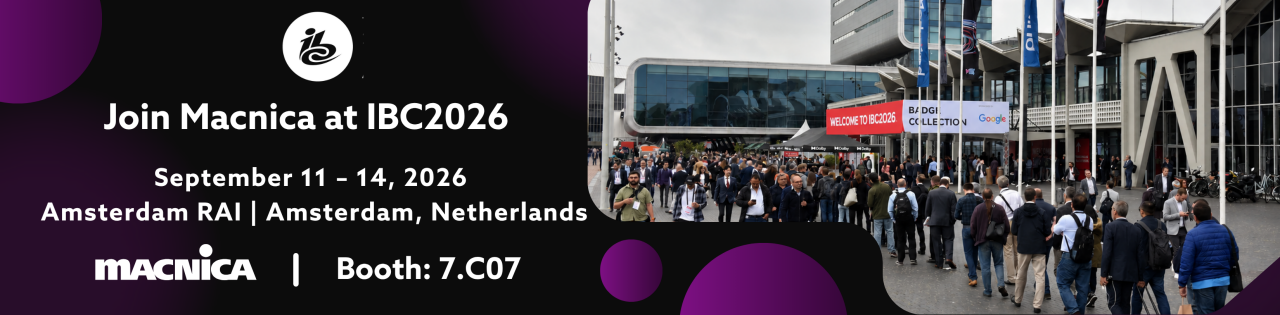
September 11 – 14, 2026 - Amsterdam RAI | Amsterdam, Netherlands - Booth: 7.C07
IBC brings together the engineering teams that build what the broadcast industry runs on. Replay, playout, graphics, encoding, monitoring and the systems around them come from teams where every engineer is already spoken for.
For those teams, adding SMPTE ST 2110 to a product is a large piece of work the customer never sees, and it competes directly with the product itself. Channel count, build cost and ship date all draw on the same resource. When the ST 2110 media layer runs in software it consumes the host cores the application was built to use, and the months spent developing and tuning the transport are months that did not go into the thing being sold.
Visit Macnica at IBC2026 and see how the MEP100 puts hardware-accelerated SMPTE ST 2110 I/O directly into a single card, so teams can build standards-based products without building the network transport layer themselves. It is running live on two platforms at stand 7.C07.
Featured Solution
MEP100
MEP100 is a 100GbE PCIe Gen4 SmartNIC that accelerates ST 2110 packetization, ST 2022-7 redundancy and FPGA-based PTP timing in hardware, running on Linux and Mac. A single card carries 32 flows in each direction, mixed freely by resolution and frame rate within the 100GbE budget, with transmit and receive running independently at nearly line rate.
Zero-copy DMA over PCIe Gen4 x16 delivers media into host or GPU memory, and NVIDIA GPUDirect is supported on Linux, so the host keeps the cores the application needs.
It integrates through the M2S SDK, GStreamer or FFmpeg, with integrated NMOS IS-04/IS-05 discovery and optional onboard JPEG XS acceleration, so the application on top gets standards-based I/O without inheriting the transport complexity underneath.
What You'll See
The stand has two independent stations, running on two platforms at two different points in the production chain.
The first station is a Mac Studio with the MEP100 in a Sonnet chassis, recording and playing back multiple channels in Softron's OnTheAir Video while a live multiviewer composites them. It shows what the card does for cost per channel on the Mac, and it is the platform on which the MEP100 carries Apple Immersive workflows, with ProRes over ST 2110-22 and ST 2110-41 fast metadata.
The second station runs high-density media processing on an Advantech server with a NETINT encoding card, so that visitors can see what a 100GbE ST 2110 front end does for throughput in a single box. It is aimed at manufacturers building at volume, who need more channels per server and would rather not write a transport layer to get them.
Softron is immediately alongside us, and wTVision is a few stands along at 7.C14, developing new graphics products on the Mac. The platform is drawing serious live production work.
Where the MEP100 fits
- A video server records and plays out multiple channels on a standard server, with ST 2110 in and out and latency low enough to edit while recording.
- A transcoding system ingests uncompressed ST 2110, transcodes on the host and delivers a compressed output, and the offloaded transport leaves room for more channels per box.
- An AI vision system feeds multiple camera flows into GPU inference for tracking and graphics, using GPUDirect for a low-latency path into the GPU.
- A multiviewer composes many ST 2110 sources into monitoring walls and operator displays, receiving up to 32 flows on one card and compositing them on the GPU.
- An immersive workflow carries ProRes over ST 2110-22 with frame-aligned ST 2110-41 metadata, on the Mac.
All of these run on the same card and the same SDK.
Schedule a Meeting
Planning to attend?
Meet with Macnica's broadcast and media technology specialists at one of the industry's premier events, to discuss your ST 2110 integration, evaluate deployment paths, and see how MEP100 fits into what you’re building.
Macnica Americas Site Map


©Copyright 2026 Macnica Americas, Inc.