

SupremeRAID™ AE

SupremeRAID™ AE (AI Edition)
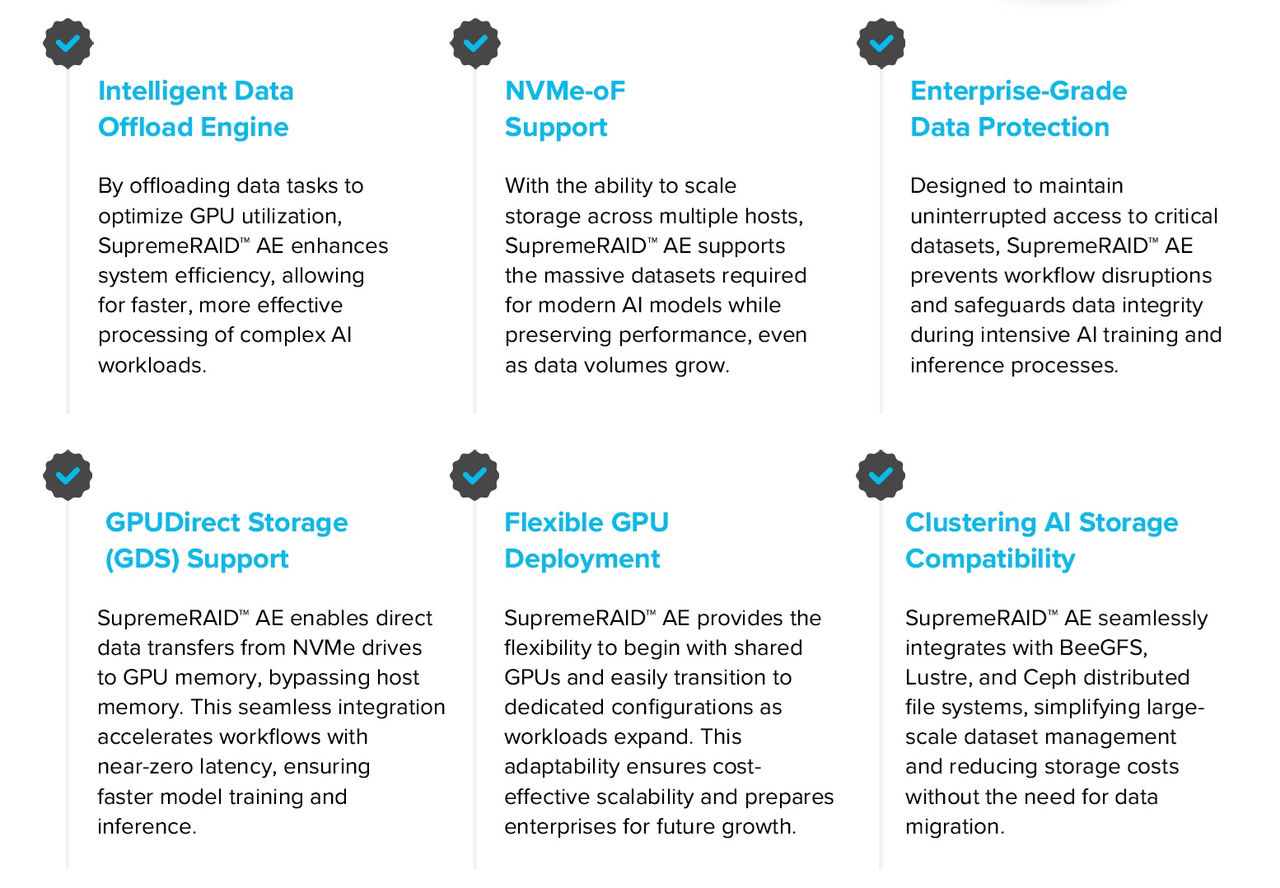
SupremeRAID™ AE (AI Edition) is a next-generation, software-defined RAID solution optimized for high-performance NVMe SSD arrays. Designed for modern data centers, AI/ML workloads, and mission-critical enterprise environments, SupremeRAID™ AE combines advanced redundancy, intelligent recovery, and seamless management to deliver unmatched data protection and operational efficiency.

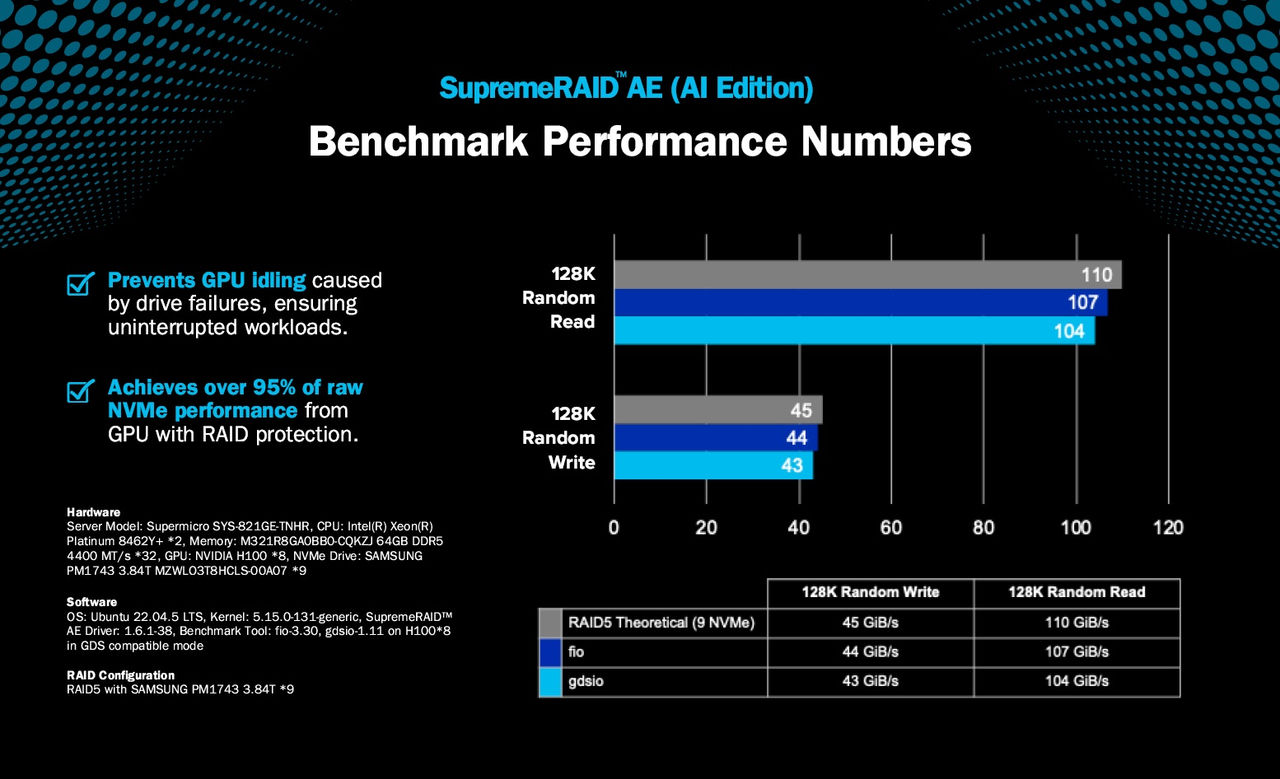
Test Configuration
Hardware
- Server Model: Supermicro SYS-821GE-TNHR, CPU: Intel(R) , Xeon(R) Platinum 8462Y+ *2,
- Memory: M321R8GA0BB0-CQKZJ 64GB DDR5 4400 MT/s *32,
- GPU: NVIDIA H100 *8,
- NVMe Drive: SAMSUNG PM1743 3.84T MZWLO3T8HCLS-00A07 *9
Software
- OS: Ubuntu 22.04.5 LTS, Kernel: 5.15.0-131-generic,
- SupremeRAID™ AE Driver: 1.6.1-38,
- Benchmark Tool: fio-3.30, gdsio-1.11 on H100*8 in GDS compatible mode
RAID Specification
- RAID5 with SAMSUNG PM1743 3.84T *9
Key Features & Technical Benefits
- Double Failure Protection with Distributed Journaling:
- Distributed journaling architecture provides double failure protection across multiple drives and controllers.
- Automated Bad Block Recovery:
- Real-time detection of uncorrectable read errors (UREs) with automated recovery using RAID parity.
- Dataset Management (DSM) Deallocate Command (TRIM) Support:
- Advanced support for TRIM commands on virtual drives, including partial stripe and parity management.
- RESTful API for Automation & Integration:
- Comprehensive RESTful API supporting full CRUD operations, HTTP response codes, and detailed status reporting.
- Intuitive Management GUI:
- Web-based graphical interface for system monitoring and management, including dashboards, event logs, and real-time statistics.
Detailed Technical Specifications
- Supported RAID levels: RAID 0, 1, 5, 6, 10
- Supported Enterprise GPUs: NVIDIA Ampere, Ada, Lovelace, Hopper, and Blackwell series
- Maximum Drives per Array: Up to 32 NVMe SSDs per array (scalable based on hardware platform)
- Supported NVMe SSDs: Gen3/Gen4 NVMe SSDs U.2/U.3, M.2, E1.S/E3.S (scalable based on hardware platform)
- Max Array Size: Up to 1PB per array (subject to hardware and OS limits)
- Host OS Compatibility: Linux (RHEL, CentOS, Ubuntu, SLES), Windows Server (2019/2022),
- VMware ESXi
- CPU/Memory Requirements: Minimum 8-core CPU, 32GB RAM (higher specs recommended for large arrays or AI workloads)
- Supported Virtualization Environments: KVM, Proxmox VE, Virtuozzo OpenVZ, VMWare Workstation Pro 17, Windows Server Hyper-V
- Network Support: 10/25/40/100GbE, RDMA-capable (RoCE, iWARP)
- Performance Optimization: Read/write performance optimized for AI workloads, NVMe multipath support, parallel rebuilds.
- Management Interface: RESTful API, Web-based GUI, CLI (Command Line Interface)
- Monitoring & Alerts: Real-time statistics, event logging, SNMP, email notifications.
- Security: Role-based access control (RBAC), audit logging, secure API endpoints (HTTPS)
- Integration: API for orchestration platforms, plug-ins for monitoring tools
- Licensing: Perpetual
Software and Documentation:
Links

Follow us on Macnica Galaxy social media




©Copyright 2026 Macnica Galaxy Inc.