



Terasic Comet A13 SOM

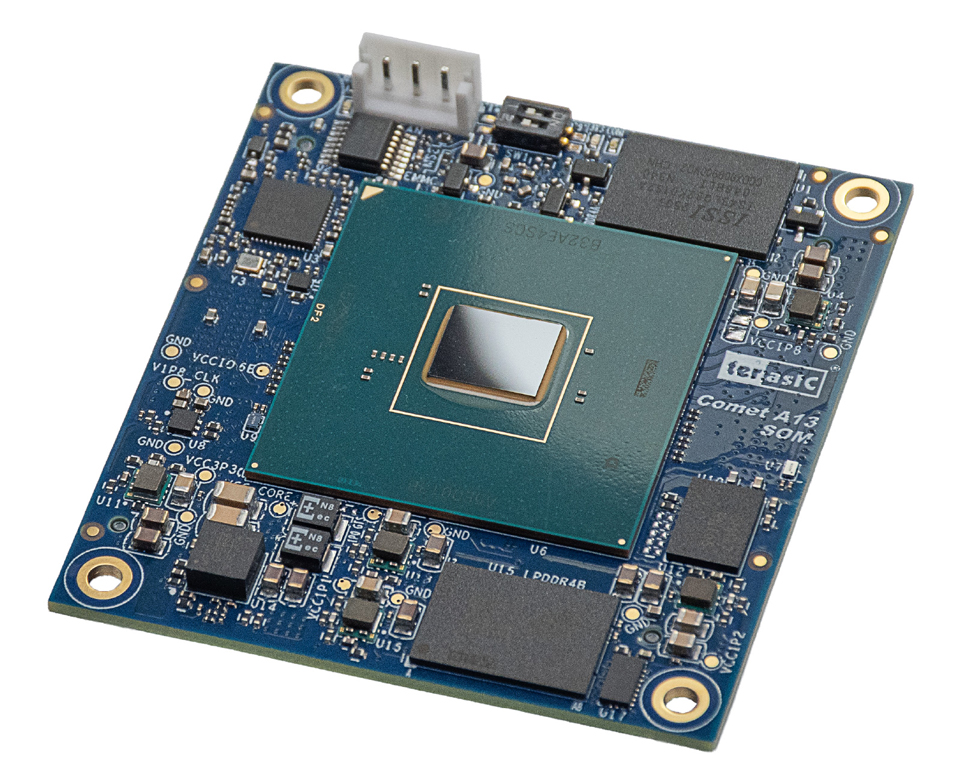
The Terasic Comet A13 is a compact System-on-Module (SoM) and Evaluation Kit built around the Altera Agilex 5 E-Series SoC FPGA (device A5ED013BB32AE4SCS). Measuring just 60 x 55 mm, the Comet A13 integrates programmable FPGA fabric with a heterogeneous Arm processor subsystem, dual-channel isolated LPDDR4 memory, and high-speed I/O expansion - all in a production-ready package designed for long lifecycle industrial deployments.
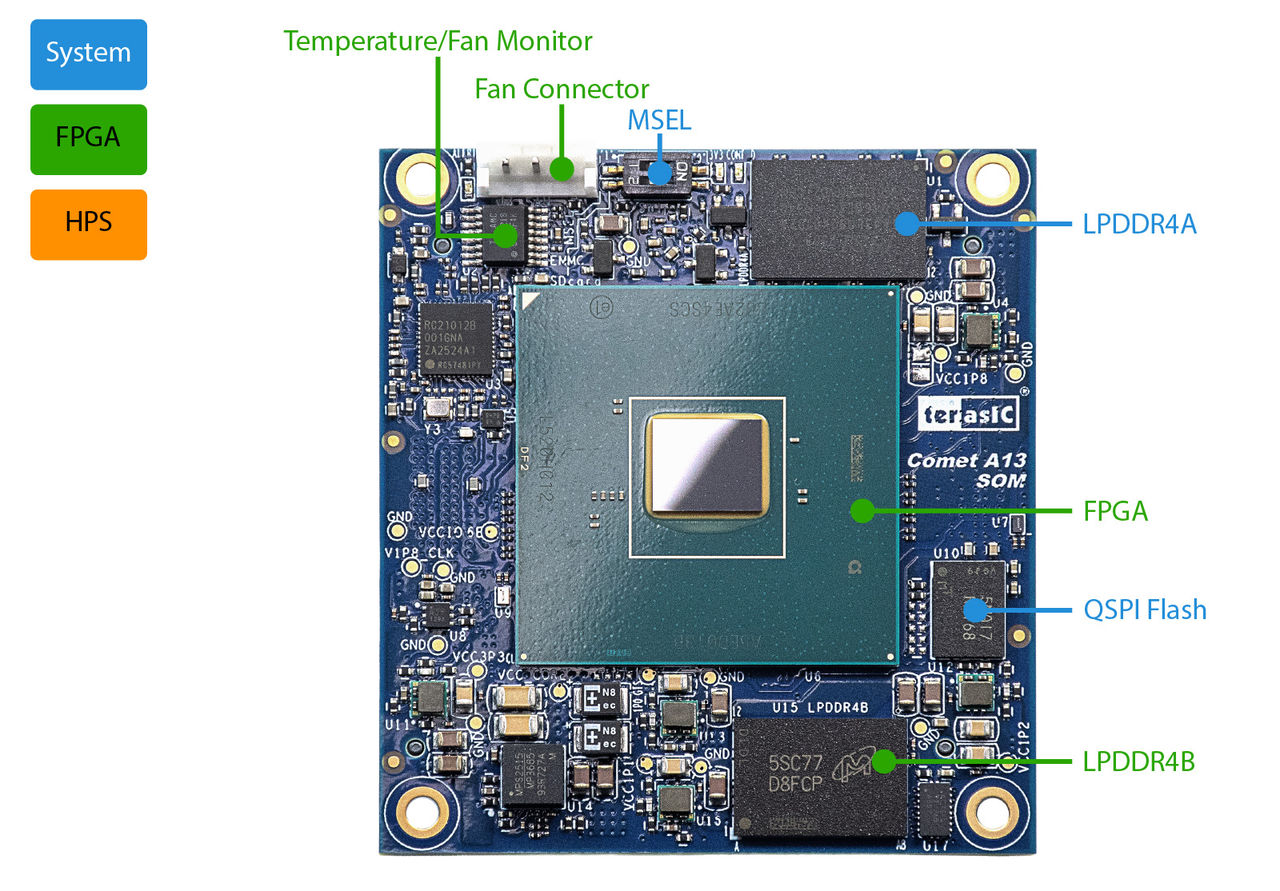
The platform targets engineers developing demanding applications in edge AI inference, machine vision, robotics, industrial automation, and embedded computing. Its hardware-isolated memory architecture, MIPI CSI-2 camera interface, and mature Linux BSP support make it equally suited for rapid prototyping and volume production.
Key Features
- Altera Agilex 5 E-Series SoC FPGA with Arm Cortex-A76 and Cortex-A55 processors
- Hardware-isolated dual-channel LPDDR4 memory: 4 GB for HPS, 1 GB dedicated to FPGA fabric
- 8 GB eMMC + QSPI flash onboard storage with both microSD and eMMC boot support
- Dual 300-pin SEAM8 connectors exposing 191 HVIO, 72 HSIO, 48 HPS I/O, and 4 transceivers at up to 17.16 Gbps
- HVIO banks support 1.8 V, 2.5 V, and 3.3 V for direct sensor and industrial peripheral attachment
- 22-pin MIPI CSI-2 connector (4-lane) for high-speed camera integration
- HDMI 1080p display output, Gigabit Ethernet, USB 2.0 OTG, USB Blaster III
- 2x20 3.3 V DE-GPIO expansion header for rapid peripheral prototyping
- Ubuntu 22.04.03 LTS with Linux Kernel 6.12.33 LTS - full BSP included
- Quartus Prime support and USB Blaster III for FPGA design and programming workflows
- Available in passive and active cooling configurations; aluminum heat spreader included
Highlights
Heterogeneous Processor Subsystem
The Agilex 5 E-Series Hard Processor System (HPS) integrates dual Arm Cortex-A76 cores for high-performance application workloads alongside dual Cortex-A55 cores optimized for real-time hardware management. This heterogeneous architecture allows software teams to run full Linux application stacks - including AI middleware, networking, and containerized services - while the Cortex-A55 cores handle deterministic, low-latency control tasks independently.
Dual-Channel Isolated Memory Architecture
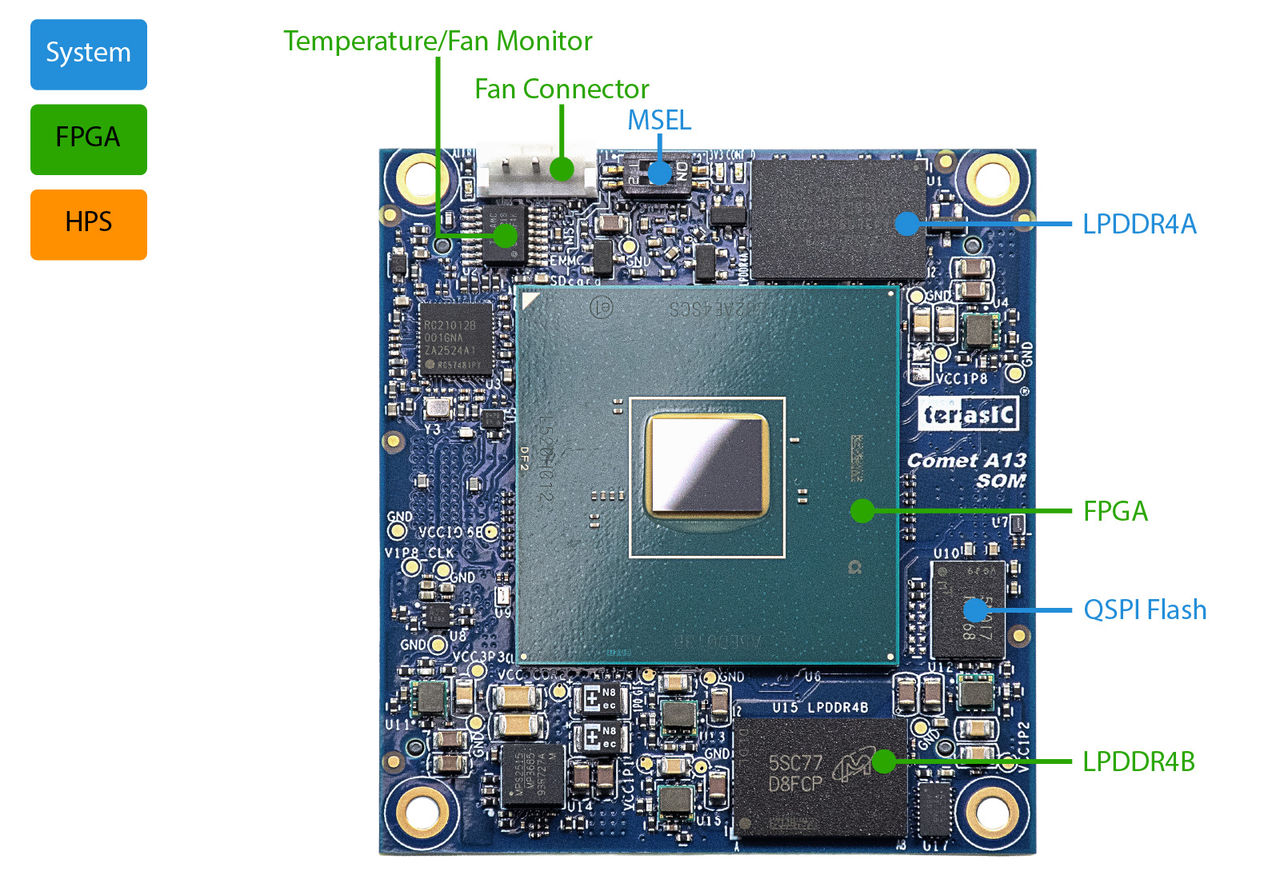
The Comet A13 implements a hardware-isolated memory topology that eliminates bandwidth contention between the HPS subsystem and FPGA fabric. The HPS connects to 4 GB of LPDDR4-A through a dedicated 32-bit interface optimized for Ubuntu 22.04 OS workloads, networking stacks, and application-layer services.
The FPGA fabric connects to a separate LPDDR4-B subsystem (1 GB in production; 2 GB in RevA engineering samples). This physically isolated memory pool is designed for high-throughput AI and vision workloads. Image streams entering through the MIPI CSI-2 interface can be buffered directly into FPGA-attached LPDDR4-B for preprocessing tasks such as denoising, color correction, feature extraction, and AI inference - all without impacting the HPS-side memory bus. The result is deterministic control-loop timing and predictable low-latency behavior critical for industrial automation and robotics applications.
High-Speed I/O and Transceiver Expansion
Through its dual 300-pin SEAM8 connectors, the Comet A13 exposes 191 HVIO, 72 HSIO, 48 HPS I/O, and four transceivers operating at up to 17.16 Gbps. HVIO banks support 1.8 V, 2.5 V, and 3.3 V signaling, enabling direct attachment of industrial sensors, cameras, and peripherals without additional level-shifting circuitry. This I/O density and voltage flexibility make the Comet A13 well-suited for custom carrier board designs in applications requiring high channel counts.
Ecosystem
Terasic provides a complete development infrastructure for the Comet A13 platform, enabling teams to move from concept to production without gaps in software support.
Linux BSP: The platform ships with an officially maintained Ubuntu 22.04.03 LTS BSP built on Linux Kernel 6.12.33 LTS. Compared to older embedded Linux distributions common in the FPGA market, this LTS kernel delivers improved heterogeneous scheduling for Cortex-A76/A55, enhanced industrial networking reliability, filesystem stability for long-duration workloads, and up-to-date peripheral driver support.
Flexible Boot and Deployment: Developers can iterate using removable microSD card images during prototyping. Production deployments can be permanently programmed to onboard eMMC using Terasic's official programming workflow, improving vibration resistance and preventing accidental storage removal in industrial environments.
FPGA Design Tools: Full Quartus Prime support is included, along with USB Blaster III programming and Linux build workflows using Ubuntu host environments. Documentation for building Linux images from scratch is also provided.
Resources Available: Ubuntu image packages for both microSD and eMMC boot targets, eMMC programming instructions, board support files, reference designs, and user manuals are all available through Terasic's official product channels.
Applications
- Edge AI inference and computer vision pipeline acceleration
- Machine vision systems: high-speed inspection, defect detection, MIPI camera integration
- Industrial robotics: AMR perception, motion control, deterministic low-latency processing
- Industrial automation: smart factory sensor fusion, protocol bridging, control systems
- Medical imaging and embedded healthcare computing
- Communications and industrial networking applications requiring high transceiver bandwidth
- Embedded systems requiring long product lifecycle (10+ years expected Agilex 5 availability)
Technical Specifications
| Specification | Details |
|---|---|
| SoC FPGA | Altera Agilex 5 E-Series (A5ED013BB32AE4SCS) - Group B |
| Processor Cores | Arm Cortex-A76 (up to 1.4 GHz) + Arm Cortex-A55 (up to 1.25 GHz) |
| FPGA Fabric | AI Tensor Acceleration Fabric with hardware-accelerated inference |
| HPS Memory | 4 GB LPDDR4-A (32-bit interface, dedicated to HPS) |
| FPGA Fabric Memory | 1 GB LPDDR4-B (production) / 2 GB LPDDR4-B (RevA) |
| Boot Storage | 8 GB eMMC + QSPI Flash |
| Module Size | 60 mm x 55 mm |
| Connector Interface | Dual 300-pin SEAM8 connectors |
| I/O (via connectors) | 191 HVIO, 72 HSIO, 48 HPS I/O |
| HVIO Voltage Support | 1.8 V, 2.5 V, and 3.3 V |
| High-Speed Transceivers | 4 transceivers, up to 17.16 Gbps |
| Camera Interface | 22-pin MIPI CSI-2 (4-lane, on carrier board) |
| Display Output | HDMI 1080p (on carrier board) |
| Networking | Gigabit Ethernet |
| USB Interfaces | USB 2.0 OTG (Type-C), USB Blaster III with UART, USB Type-C Linux terminal |
| GPIO Expansion | 2x20 3.3 V DE-GPIO header |
| Operating System | Ubuntu 22.04.03 LTS |
| Linux Kernel | Linux Kernel 6.12.33 LTS |
| Boot Options | microSD and onboard eMMC |
| Cooling | Aluminum heat spreader standard; passive and active cooling versions available |
| Thermal Guidance | Active cooling recommended above 7 W or 85% logic utilization above 200 MHz |
Evaluation Kit and Ordering
The Comet A13 is available as a standalone SoM or as part of a complete Evaluation Kit that includes both the SoM and a full carrier board. The evaluation kit is designed for early-stage algorithm validation, AI pipeline benchmarking, and proof-of-concept development, allowing engineering teams to reduce the time required for custom carrier board development.
Optional ecosystem accessories available from Terasic include:
- Sony IMX519 MIPI CSI-2 camera module (compatible with the onboard 22-pin connector)
- Active cooling fan module
- microSD firmware development kits
Interested in the Terasic Comet A13 Development Kit?
Macnica Americas Site Map


©Copyright 2026 Macnica Americas, Inc.