



FPGA Accelerators for Industrial Edge AI

FPGA Accelerators in Industrial Edge AI: Where Programmable Logic Fits
Industrial edge AI must deliver useful decisions at the speed the production process needs them. On an electronics assembly line, for example, detecting a misplaced component on a printed circuit board is only part of the task. The inspection system must also capture a clear image, process it and communicate the result while there is still time to act.
GPUs and dedicated AI accelerators provide powerful options for inference. However, applications combining demanding sensor interfaces and changing requirements that need predictable response times can benefit from another approach: field-programmable gate arrays, or FPGAs. These devices allow engineers to configure hardware around the processing task and modify that configuration as requirements evolve. For manufacturers, this creates opportunities to improve inspection and process control while supporting equipment that may remain in service for decades.
Making response times predictable
A high inference rate does not automatically translate into a reliable production process. An inspection system might handle many images per second on average. But if it occasionally delivers a result too late for a downstream sorting mechanism, that can be a major problem when each decision must correspond to a particular product moving through the production line efficiently.
FPGAs can implement dedicated processing pipelines that move data through successive hardware stages with tightly controlled timing. Suitable image operations can begin as soon as the pixels arrive, reducing the need to collect an entire frame before processing starts. Multiple camera streams can have parallel processing paths, provided the device has sufficient resources and bandwidth.
This helps engineers control latency and jitter (the variation in response time). In contrast, a processor-based implementation may need additional measures to manage scheduling, shared memory access and competing workloads. An FPGA lets designers allocate hardware directly to the functions that need predictable behavior.
That predictability still requires engineering. Buffering, external memory and downstream congestion can introduce delays in an FPGA system too. Evaluating a deployment should therefore measure the complete interval from sensor capture to actionable output, including worst-case behavior under the intended operating conditions.
Bringing the inspection pipeline together
As an example, consider an inspection station checking populated circuit boards like the one we mentioned at the beginning of this article. Cameras could identify missing components, incorrect orientation or visible assembly defects. Before an AI model can evaluate those images, the system may need to correct defective pixels, reduce noise caused by lighting conditions, adjust color or resize the image.
An FPGA can perform all these tasks in one hardware chain, combining sensor interfacing, image preprocessing, inference and postprocessing within a single device. The output might identify a suspect component, trigger further inspection or send a result to the machine controller. Networking and selected control functions can also be integrated, depending on the device and system architecture.
Bringing these operations together can reduce transfers between separate chips and their associated memory storage systems. It can also remove components from the bill of materials and save board space. These benefits are particularly relevant inside compact cameras or tightly packaged production equipment.
The value comes from matching the pipeline to the application. A camera inspecting one component type may require a relatively small model. Processing several high-resolution streams, or distinguishing subtle defects, will place different demands on logic, memory and numerical precision.
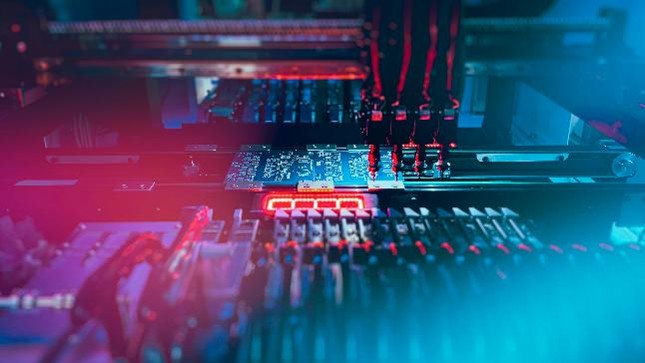
Engineers can explore lower-precision arithmetic to reduce resource requirements, then test whether detection accuracy remains acceptable. The correct balance depends on representative production data, including difficult defects and normal product variation. A smaller implementation is useful only if it still makes dependable inspection decisions. The key is to test with real data for the specific implementation.
For the PCB inspection example, a useful trial would track missed defects, false rejects and decision latency at the required line speed.
Testing all camera streams together also exposes bandwidth limitations that an isolated model benchmark can miss. These measurements connect hardware choices directly to production performance and yield.
Deploying FPGAs alongside other processors
Programmable logic can also improve systems that retain a GPU for AI inference. An FPGA might aggregate several sensor streams, synchronize incoming data and convert it into the format the GPU expects. Image cleanup or other repetitive processing can happen before the data reaches the inference engine. This division of work allows the GPU to concentrate on the model while programmable logic handles demanding input and preprocessing requirements. This is particularly useful when the movement and organization of data has become a bottleneck.
Alternatively, an FPGA can host inference alongside other functions, with a general-purpose processor managing configuration, communications and the user interface. Some system-on-chip FPGAs combine processor cores with programmable logic to support this arrangement.The architecture decision should follow the workload. A straightforward control task may be served more economically by a readymade microcontroller. A supported, stable inference workload may favor a dedicated AI accelerator. FPGAs become especially attractive when the design needs custom interfaces, parallel processing and flexibility together at once.
Keeping equipment adaptable over its lifetime
Industrial machinery often outlasts several generations of computing hardware. During that period, manufacturers may introduce new products, change sensors or discover that an inspection model needs greater accuracy. Replacing an entire processing board for every change can add cost and interrupt production. Programmable logic provides room to adapt. Engineers can revise image processing, change control timing or implement a different supported inference architecture. Where the existing hardware has sufficient capacity, these changes can be delivered through an updated FPGA configuration.
However, avoiding a board redesign depends on decisions made at the outset. Additional logic, memory capacity and bandwidth may be needed later. A replacement sensor must remain compatible with the available connections and electrical interfaces. Reprogramming cannot create a missing connector or boost an inadequate power supply. Lifecycle planning should therefore include realistic expansion capacity, device availability and the tools needed to maintain the design. Updated configurations also require validation. Reusing the board reduces hardware disruption, but it does not remove the need to verify timing, accuracy and system behavior.
This flexibility is particularly valuable where standards or algorithms are still evolving. Engineers can change the implemented hardware data path within the FPGA's capabilities, extending the options beyond software updates on a fixed accelerator architecture.
Build from proven tools and designs
FPGA development requires specialist skills, but engineers do not need to create every function from scratch. Reusable intellectual property, or IP, provides building blocks for interfaces, image processing and other functions. Reference designs and development boards offer starting points for testing the proposed pipeline.
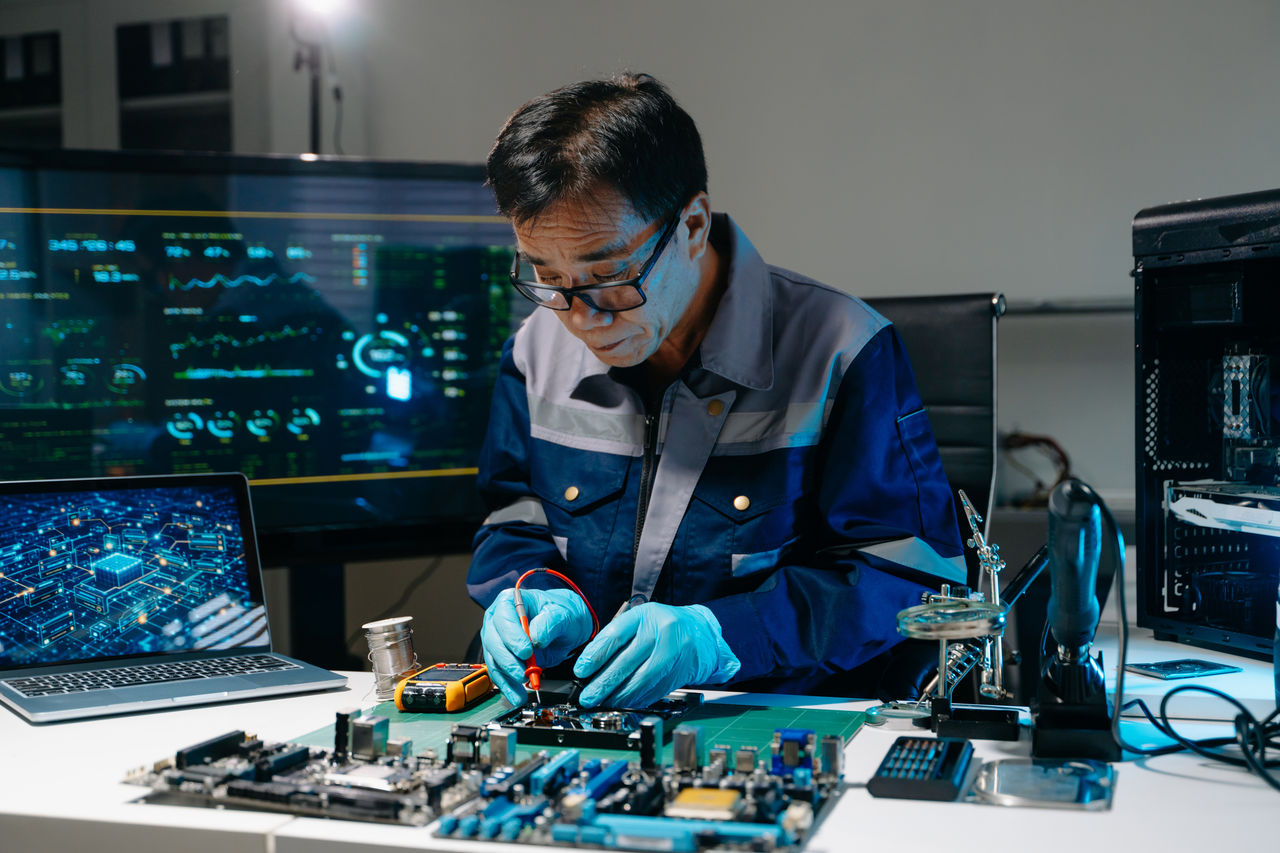
For example, programmable logic can receive and synchronize multiple camera streams that use different interfaces, frequencies and data formats, then align and preprocess that data before it reaches an inference engine. Altera FPGAs include hardened MIPI CSI-2/D-PHY interfaces, which bring image sensor data on-chip without consuming general-purpose logic. Macnica's own SLVS-EC receiver IP extends that same support to sensors using the SLVS-EC interface common in industrial and machine vision cameras. Depending on the application, the FPGA can also host portions of the AI workload, manage system control and provide connectivity to the rest of the machine.
These capabilities reduce development effort, but AI model compatibility, resource allocation and timing closure still need attention. Timing closure means ensuring the implemented circuit meets its required timing constraints. Teams should budget for integration and verification, alongside model development.
How Macnica helps evaluate the whole system
Selecting an FPGA for an industrial imaging application is only one part of the architectural decision. The larger question is how to partition the complete system across the image sensor, high-speed interfaces, programmable logic, memory, processors and AI acceleration.
Macnica can help engineering teams evaluate their architecture and identify where programmable logic can provide the most value. The process can start with the customer's required image resolution, frame rate, sensor interfaces, processing algorithms, latency requirements and system outputs. From there, engineers can evaluate the appropriate FPGA device, memory architecture, image-processing pipeline and AI implementation.
For example, programmable logic can receive and synchronize multiple high-bandwidth camera streams, perform image preprocessing and move data efficiently to an inference engine. Depending on the application, the FPGA can also host portions of the AI workload, manage system control and provide connectivity to the rest of the machine. The objective is not simply to put more functions into an FPGA, but to determine which functions benefit from programmable hardware and which are better handled elsewhere.
Macnica provides access to Altera FPGA devices, development platforms and IP, including its own SLVS-EC receiver IP core, along with engineering support that can help move an architecture from concept to implementation. Support can range from device selection and proof-of-concept development through system architecture, FPGA design, optimization and production planning.
For industrial edge AI, programmable logic remains compelling wherever precise timing and adaptable processing deliver practical value. With the right architecture, manufacturers can build inspection and control systems that meet today's production requirements while retaining capacity to evolve with tomorrow's products.
Macnica Americas Site Map


©Copyright 2026 Macnica Americas, Inc.