



Mitsubishi Estate Turns to icetana AI to Counter Labor Shortages with a Next-Generation Security Model

Mitsubishi Estate Co., Ltd., one of Japan’s leading real estate developers, manages a diverse portfolio of offices, commercial facilities, hotels, airports, and mixed-use properties in the Daimaruyu area, which combines Otemachi, Marunouch, and Yurakucho (OMY).
The OMY district is home to numerous Japanese and international corporate headquarters, including those near Tokyo Station and the Imperial Palace. It represents a blend of tradition and modernity, with historic landmarks alongside modern skyscrapers, and serves as a focal point for smart-city initiatives and urban development.
As public spaces grew more active, the company re-evaluated its approach to protecting tenants and visitors. A shrinking labor force, rising wages, and increasing expectations around safety led Mitsubishi Estate to pursue a next-generation security model built on AI security surveillance.
The Challenge: Rising Security Demands Amid Labor Shortages
Security operations are essential to facility management across Mitsubishi Estate’s properties. Teams monitor hundreds of cameras, conduct patrols, respond to events, and safeguard environments that host diverse populations and assets.
Staffing those roles has become increasingly difficult amid a shortage of security professionals and rising wages. The environment around the OMY has also grown more complex, with visitors moving at different speeds, using facilities in different ways and creating unpredictable safety scenarios.
Falls, unsafe escalator behavior, abandoned items, and bicycle parking around entrances were persistent concerns requiring constant attention.
“The security and safety of visitors at the OMY is critical,” said Rio Kamaji, manager of Mitsubishi Estate’s Marunouchi property management department and DX promotion department. “We needed to take immediate action to address the shortage of security personnel and provide greater security and safety to visitors. To this end, it was essential to introduce new technologies such as artificial intelligence.”
The Solution: icetana AI and an Unusual Activity-Based Detection Model
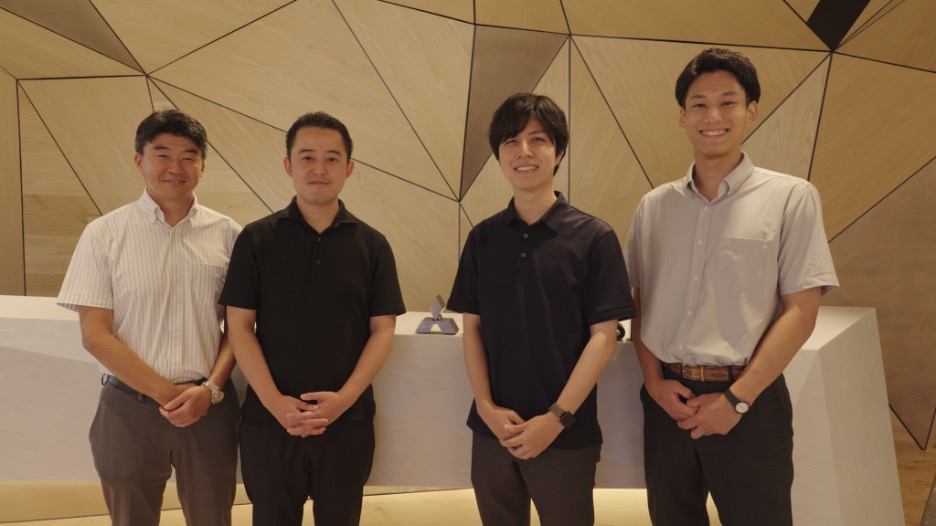
From left: Macnica / Ichitaro Shibuya MITSUBISHI ESTATE Co., Ltd. Ltd. / Mr. Rio Kamaji MITSUBISHI ESTATE Co., Ltd. Ltd. / Yusuke Yamada Macnica
Mitsubishi Estate began exploring AI-based surveillance that could help security teams detect abnormal behavior in real time, reduce manual monitoring workloads, and strengthen prevention capabilities.
ALSOK Tokyo Co., Ltd., the company’s security firm, introduced Mitsubishi Estate to icetana AI and Macnica Americas for a self-learning image analysis solution that models each camera’s normal state and flags unusual activity without requiring predefined rules.
“We wanted to adopt something that the security guards who actually use the system thought would be good technology, so it was a welcome offer,” said Ichitaro Shibuya, Mitsubishi Estate general manager. “At the time, we hadn’t heard of a solution that could analyze images, so we asked icetana AI to verify it.”
The company conducted a seven-month validation pilot in June 2021 to determine ideal camera locations, operating conditions, and detection priorities. One early success came from identifying and preventing illegal bicycle parking, demonstrating icetana AI’s ability to detect subtle abnormalities in busy environments.
Based on pilot results, Mitsubishi Estate deployed icetana AI across the Marunouchi Building and Shin-Marunouchi Building. With a combined 75 above-ground floors and eight below-ground, the buildings serve a mix of office tenants, retail traffic, and tourists. It presented a prime opportunity to test scalable, AI-supported security operations.
Results: Expanded Coverage and Earlier Detection
Before icetana AI, Mitsubishi Estate’s security model relied heavily on patrols and manual camera reviews. Guards were responsible for monitoring more than 100 feeds, creating physical strain and the constant risk of missed incidents.
icetana AI’s unusual- or dangerous-event detection significantly increased situational awareness. Because it learns normal conditions, the platform can identify deviations, including behaviors that security teams might not anticipate or have time to catch.
With icetana AI, Mitsubishi Estate’s security teams were able to detect:
- Unsafe escalator behaviors
- Falls inside buildings
- Illegal bicycle parking
- Smoking around entrances
“The only way to improve the quality of the security system up until now was to increase the frequency of patrols and make sure not to miss the footage from more than 100 cameras. We are seeing results in more advanced security,” Kamaji said.
Security leaders also reported reduced monitoring demands and better allocation of personnel. Instead of continuously scanning video feeds, teams focus on responding to surfaced events.
Mitsubishi Estate now relies on icetana AI to evolve with its operational needs. On-site guard feedback informs ongoing enhancements, algorithm refinements, and usability improvements. icetana AI is continually updated with data from the company’s security teams, which operators described as easy to learn and use.
Looking Ahead: Scaling Across Properties
As Mitsubishi Estate continues to optimize its security model, the company is considering additional deployments of icetana AI-enabled cameras across other buildings and regions.
It is also planning to expand security capabilities with automation, robotics, and integrated video solutions tailored by Macnica for each facility’s scale.
For Mitsubishi Estate, icetana AI and Macnica are part of a long-term strategy to build a resilient, scalable, and data-driven security model that addresses labor shortages while improving safety and operational performance.
From reduced reliance on manual monitoring to broader detection of real-world events and measurable relief on security teams, icetana AI and Macnica have become central to Mitsubishi Estate’s vision for modern facility management.
Editorial Note: This article reflects the content at the time of the interview.
Related Articles





Macnica Americas Site Map


©Copyright 2026 Macnica Americas, Inc.