


Falcon Takes Flight: Connect Tech's Vehicle AI Platform Was Built for the Worst Conditions on Earth
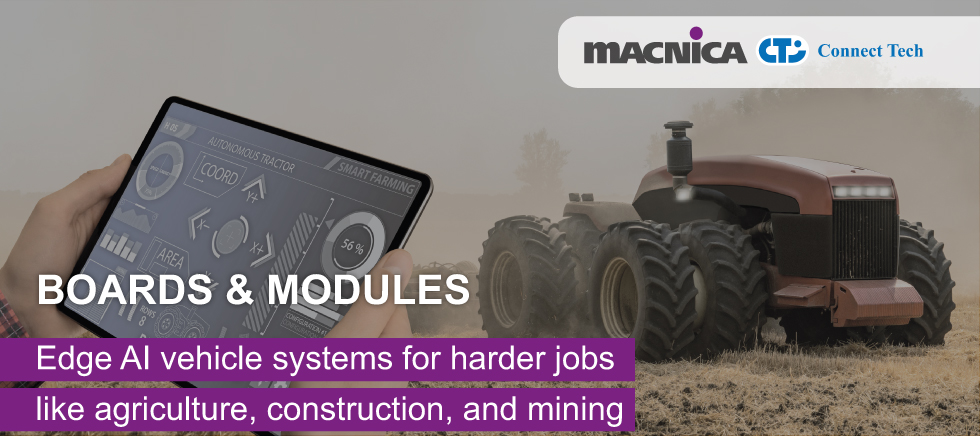
Dust. Vibration. Mud. Sub-zero mornings and scorching afternoons. These are the conditions that kill most compute platforms before they ever reach production, and yet it's exactly these conditions, on farms, construction sites, and open-pit mines, where the need for real-time, on-machine intelligence is becoming critical.
Connect Tech Inc. had one answer: build something that doesn’t flinch.
The result is the Falcon Vehicle System, a production-ready, IP67-rated Edge AI compute platform powered by the NVIDIA Jetson Orin NX, designed from the ground up to mount directly onto heavy equipment and operate in the field. Launched at CONExpo in March 2026, Falcon went on to earn a Best-in-Show award at embedded world Germany 2026 in the AI and Machine Learning category.
The Problem Nobody in the Industry Wants to Talk About
Labor shortages, tightening safety regulations, and rising operational pressure are pushing agriculture, construction, and mining operators toward autonomous and assisted technologies faster than many are ready for. The barrier isn’t ambition. It’s environment.
Machines in these industries operate in places where cloud connectivity is inconsistent, temperatures swing between extremes, and every workday brings shock, vibration, and exposure to contaminants that quickly degrade standard hardware. Traditional compute approaches such as cloud-dependent inference, off-the-shelf industrial PCs, and enclosure-based deployments were not designed for this.
As Rob Callaghan, Chief Product Officer at Connect Tech, put it: “In agriculture, construction, and mining, the environment is the first test. If a system can’t withstand dust, vibration, heat, and moisture, autonomy is irrelevant.”
Falcon was built to meet that requirement first.
Macnica Americas' FAE Manager Chris Cook and Connect Tech's Support Applications Engineer Manager David Pearson discuss the Falcon Vehicle System and what it takes to build production-ready AI for heavy equipment, how it earned Best-in-Show at embedded world Germany 2026, and what it actually means to deploy Physical AI on a machine in the field.
Check out the full discussion below.
On The Machine
What sets Falcon apart from many vehicle AI solutions is where it is designed to operate: directly on the machine.
Mounting on-machine reduces sensor cable length, lowers latency, and allows decisions to be made locally without relying on network connectivity.
To support this, Falcon is:
- Fully fanless with no active cooling components
- Sealed to IP67 standards for protection against dust and water ingress under defined conditions
- Designed for continuous operation under vibration, heat, and environmental exposure
This is a system intended for integration into working equipment, not staged deployment or protected installation.
What the NVIDIA Jetson Orin NX Unlocks
Falcon is built on the Jetson Orin NX with Super Mode support, enabling higher performance profiles for more demanding workloads.
This supports:
- Multi-camera perception pipelines
- Sensor fusion
- Real-time inference at the edge
Workloads are processed locally, which is critical for systems operating in disconnected or latency-sensitive environments.
Falcon is designed and validated to sustain performance under continuous load within defined operating conditions. That distinction matters. Edge AI performance must be maintained over extended operation, not just demonstrated in short-duration scenarios.
The Jetson Orin NX also provides access to the NVIDIA software ecosystem, including TensorRT for optimized inference, DeepStream for multi-stream video analytics, and JetPack as the development foundation. For teams already working within this environment, the path to deployment is direct.
What It Actually Does on a Jobsite
Falcon’s capabilities translate into deployable applications that align with real operational needs.
In-cab operator assistance supports context-aware alerts, improved situational awareness, and interaction without relying on connectivity.
Safety systems enable proximity detection and collision avoidance by continuously monitoring personnel and obstacles. Combined with 360-degree surround vision, operators gain visibility into blind zones that have historically contributed to incidents.
For grading, trenching, and compaction work, Falcon supports machine guidance and path tracking, maintaining alignment with predefined surfaces or routes. Fleet-level monitoring processes diagnostic data locally to identify potential failures before they lead to unplanned downtime.
The I/O Side of the Story
The connectivity design reflects how vehicle systems are actually integrated.
Falcon includes:
- Four GMSL2 camera inputs
- Dual T1 Ethernet supporting 100BASE-T1 and 1000BASE-T1
- Gigabit Ethernet
- Two CAN 2.0B interfaces
- M.2 NVMe via PCIe Gen4 x4
- USB for peripheral support
- Optional WiFi, Bluetooth, and global 5G
- Wide-range DC input for varying vehicle electrical systems
A key part of the design is how these interfaces are exposed.
Most vehicle-facing I/O is routed through an Ampseal connector, which is widely used across automotive and heavy equipment platforms. This allows Falcon to integrate directly into existing vehicle harnesses without requiring new cabling approaches, reducing integration time and aligning with established design practices.
Where rugged external connectivity is required, Falcon uses M12 connectors for interfaces such as Gigabit Ethernet and antenna connections. M12 connectors are designed for harsh environments, providing mechanical stability and environmental sealing when properly mated.
This approach keeps integration clean while ensuring external connections hold up in the field, aligning with how customers already design their systems.
Built on Automotive-Grade Foundations
Falcon’s interface architecture aligns with standards commonly used in vehicle systems.
GMSL2 enables high-resolution video transmission over long cable distances with support for synchronization and control. T1 Ethernet supports single-pair networking used in modern vehicle architectures. CAN 2.0B provides direct access to control and diagnostic networks.
This alignment reduces integration complexity and supports compatibility with existing sensor and network ecosystems.
Starting from a Validated Platform
Falcon ships pre-configured with a platform-specific JetPack BSP that has been validated for the system.
This allows teams to begin development from a known baseline rather than starting with hardware bring-up and low-level debugging.
For customers requiring additional support, Connect Tech provides engineering services to assist with integration and deployment through to production.
embedded world Best-in-Show: What It Means
The Best-in-Show program at embedded world evaluates entrants against a 15-point rubric covering design excellence, relative performance, and market impact.
Third-party recognition of this kind carries weight not because tradeshow awards are the final word on anything, but because it reflects judgment from people who spend their careers evaluating embedded hardware. For engineers and program managers doing their own due diligence on vehicle AI platforms, it's a useful data point alongside the spec sheet.
Why Connect Tech and Why Now
Connect Tech was founded in 1985 in Guelph, Canada, and has spent the past four decades manufacturing embedded and Edge AI platforms in-house. As an NVIDIA Elite Partner (the highest tier in the program), the company has significant Jetson platform experience.
Through its partnership with Macnica Americas, Connect Tech's platforms are backed by engineering support, supply chain depth, and distribution infrastructure that help customers move from evaluation to deployment at a realistic pace. For teams building vehicle AI systems that need to ship at scale, that combination of technical expertise and go-to-market support is what turns a compelling product into a production program.
Heavy equipment is getting smarter. The question facing OEMs, integrators, and fleet operators is no longer whether to deploy AI; it's which platform can survive the environment long enough to make it worthwhile.
Falcon has already answered that in the field.
To evaluate the Falcon Vehicle System or speak with a Connect Tech specialist, contact the Macnica Americas team.
Related Articles

Macnica Americas Site Map


©Copyright 2026 Macnica Americas, Inc.