



DEEPX: Enabling Autonomous Robotics for the Smart Factory

Manufacturing is entering a new era where robotics, machine vision, and AI operate continuously across the factory floor. Building intelligent robots for industrial environments is not just a software problem. It is a system challenge involving perception, real-time decision making, power constraints, and reliable connectivity. Macnica helps robotics developers design edge AI architectures that enable robots and intelligent machines to operate reliably in Smart Factory environments. Using our Capture → Process → Communicate philosophy, we combine advanced sensing, efficient on-device AI processing powered by DeepX, and deterministic communication to enable autonomous robotics at scale.
- Robotics
- Edge AI
- Design
- AI Workloads
- Applications
- Developers
Robotics as the Foundation of the Smart Factory
Smart factories are built on networks of intelligent machines that continuously monitor, analyze, and optimize industrial operations.
These environments rely heavily on robotics systems, such as:
- Autonomous mobile robots moving materials
- Machine vision systems inspecting production lines
- Intelligent logistics platforms coordinating warehouse operations
- Robotics systems assisting workers safely on the factory floor
Edge AI plays a critical role in enabling these systems to operate safely and efficiently.
Smart factories rely on AI-powered automation, predictive maintenance, and quality control, where machines continuously analyze their environment and adapt to changing conditions.
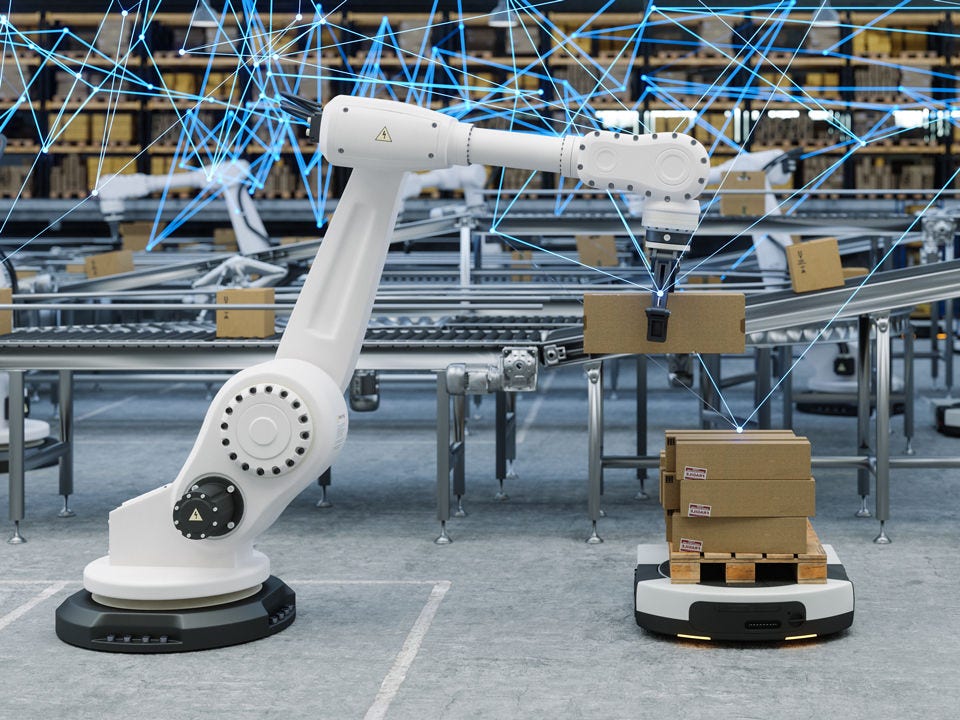
Why Robotics Needs Edge AI
Factory robots must respond instantly to changing conditions.
That means AI must run inside the robot or machine, not in distant data centers.
Edge AI enables robotics systems to:
- Process multiple sensors simultaneously: Robots combine cameras, LiDAR, and other sensors to understand their environment.
- Make real-time decisions: Navigation, obstacle detection, and task coordination require millisecond response times.
- Operate reliably without cloud dependence: Factories cannot tolerate interruptions caused by connectivity issues.
- Run within tight power budgets: Battery-powered robots must operate efficiently to maximize uptime.
These requirements make on-device AI processing essential for industrial robotics.
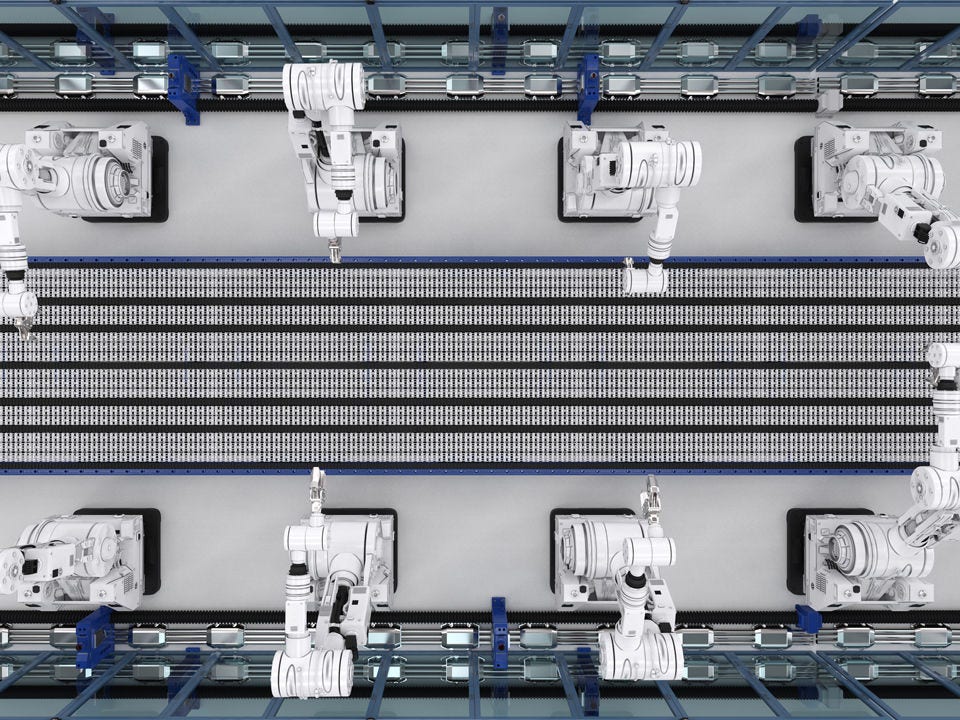
Capture → Process → Communicate for Smart Factory Robotics
Macnica helps customers design robotics systems using an integrated architecture that connects sensing, AI inference, and system coordination.
Capture
Process
AI inference engines analyze sensor data and run robotics perception models in real time.
DeepX accelerators enable robotics systems to process:
- Object detection models
- Navigation and SLAM algorithms
- Safety monitoring systems
- Predictive maintenance analytics
All while operating within practical power and thermal limits.
This enables robots to operate autonomously on the factory floor without reliance on centralized GPUs.
Communicate
Robotics systems must coordinate with other machines and factory infrastructure.
Macnica enables communication through:
- industrial networking platforms
- edge-to-cloud data pipelines
- deterministic connectivity for robotics fleets
This allows robots to operate as part of a coordinated Smart Factory ecosystem.
Autonomous robots must run multiple AI models simultaneously.
Examples include:
- Obstacle detection
- Pallet recognition
- Human safety detection
- Navigation and localization
- Anomaly detection on equipment
Efficient AI acceleration allows these workloads to run concurrently without increasing system complexity or power consumption.
Edge AI powered robotics supports a wide range of Smart Factory applications.
- Autonomous Material Handling: Robots transport parts and materials across manufacturing facilities.
- Intelligent Quality Inspection: Machine vision systems automatically detect defects during production.
- Predictive Maintenance: AI models detect early signs of equipment failure.
- Worker Safety Systems: Robots monitor environments and detect potential hazards.
By embedding intelligence directly into robotics platforms, Smart Factories can improve productivity, safety, and operational resilience.

Why Robotics Developers Work with Macnica
Macnica helps robotics teams move from concept to deployment by supporting the full system architecture.
We assist with:
- AI system architecture design
- Sensor and compute selection
- Robotics AI accelerator integration
- Networking and connectivity solutions
- Global supply chain and lifecycle management
This helps robotics developers deploy scalable AI systems across Smart Factory environments.

Build the Next Generation of Smart Factory Robotics
If you are designing robotics platforms for manufacturing, logistics, or industrial automation, Macnica can help you build an efficient edge AI architecture.
Similar Products
Macnica Americas Site Map


©Copyright 2026 Macnica Americas, Inc.