



The NB7401: High-Precision Secondary Protection for 2-to-4-Cell Battery Packs
Battery safety has quietly moved from a compliance requirement to a business priority. Regulators are tightening the rules, insurers are paying closer attention to incident data, and end customers are far more aware than they used to be of what can go wrong with lithium-ion power. For any company building products around multi-cell packs, from cordless power tools to portable medical and industrial equipment, the cost of a single field failure now far outweighs the small savings once gained by economising on protection.
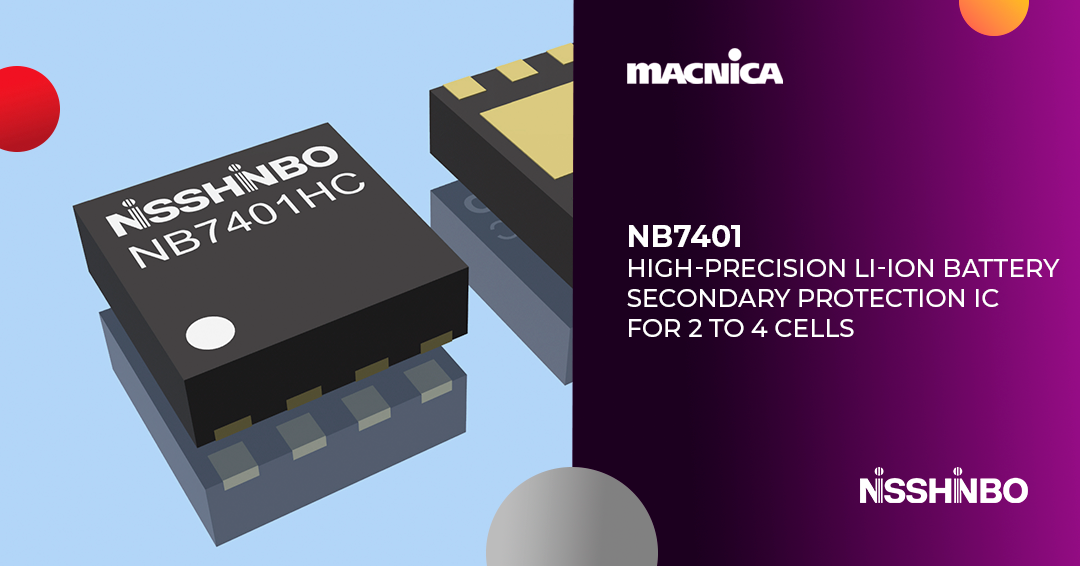
In this context, Nisshinbo Micro Devices has launched the NB7401, a high-precision secondary protection IC for 2-to-4-cell lithium-ion and lithium-polymer battery packs. This release is a direct response to where the market is heading.
Understanding Secondary Protection
Understanding Secondary Protection
Battery protection works in two distinct layers.
Primary protection does the everyday work. It manages normal charge and discharge cycles and monitors basic voltage and current limits. Under normal conditions it is entirely sufficient, and it handles almost the entire life of the pack without issue.
Secondary protection is the backup for when the primary layer fails or stops responding. That is the vulnerable moment secondary protection is built for. The NB7401 works independently of the primary circuit, watching for abnormal overcharge conditions on its own. When it detects a genuine fault, it triggers a fuse-blowing mechanism that permanently interrupts the charging path. Because the action is permanent, a dangerous overcharge cannot continue even if the rest of the system has failed, which is what prevents hazards such as overheating or cell rupture.
Independence is what separates a real backup from a false sense of security. A protection layer wired into the circuit it monitors can fail alongside it, whereas the NB7401 operates apart and stays ready when the primary layer goes down.
The Key Features
The NB7401 supports 2-to-4-cell packs with a supply voltage tolerance up to 32 V, and comes in a compact package suited to small products.
The benefits that tend to matter most to product teams:
- Independent overcharge protection that keeps working even if the primary circuit fails, reducing the risk of a serious field failure
- High detection accuracy, supporting tighter and more confident safety margins
- Low power consumption : typically 1.5 µA in operation and a maximum of 0.2 µA in standby, to preserve charge and shelf life
- Flexible configuration, with selectable trip voltages, delay times, and output voltages
- Optional temperature monitoring using an external thermistor, adding a heat-based safety layer on top of voltage protection
- A built-in voltage regulator (1.2 V to 3.3 V) to power small external components and reduce parts count
For a product team, the combination is compelling: reliable protection, good efficiency, and resistance to false trips, backed by enough configuration options to cover an entire range. That means standardising on the NB7401 family and selecting the right settings per design, instead of qualifying a separate part for every product.
What it Means for Your Design
Choosing a protection IC is about managing risk sensibly. Two failure modes matter most, and the NB7401 addresses both.
The first is a protection layer that trips when it should not. False trips create returns, frustrate users, and chip away at confidence in the product. The optional delay lets brief noise pass while still catching real faults quickly, which keeps nuisance trips down without slowing the response to genuine danger.
The second is a protection layer that fails to act. This is the more serious failure, because its cost can extend well beyond one unit into recalls, liability, and brand damage. The NB7401's independent operation and permanent cutoff are designed precisely to make sure the pack is protected in the moment the primary layer cannot help.
There is also a practical efficiency benefit. With very low current draw in both operation and standby, the device protects the pack without noticeably shortening its runtime or shelf life. And because it is offered in multiple configurations, a team can pick the right settings for each product and reuse the same family across a line, simplifying qualification and supply.
Make Your Next Design Safer
The NB7401 turns a difficult trade-off into a manageable one, letting teams strengthen battery safety without the usual penalties that make designers hesitate. For products where a fault carries real consequences, that changes the calculation from whether to add secondary protection to how soon it can be designed in.
As an official distribution partner of Nisshinbo Micro Devices in EMEA, Macnica ATD Europe helps you find the right fit and supports your project with local expertise, from evaluation to implementation.
Have a design in mind?
Contact our team to find the right configuration for your application.

Links
Follow us on social channels

©Copyright 2026 Macnica ATD Europe SAS